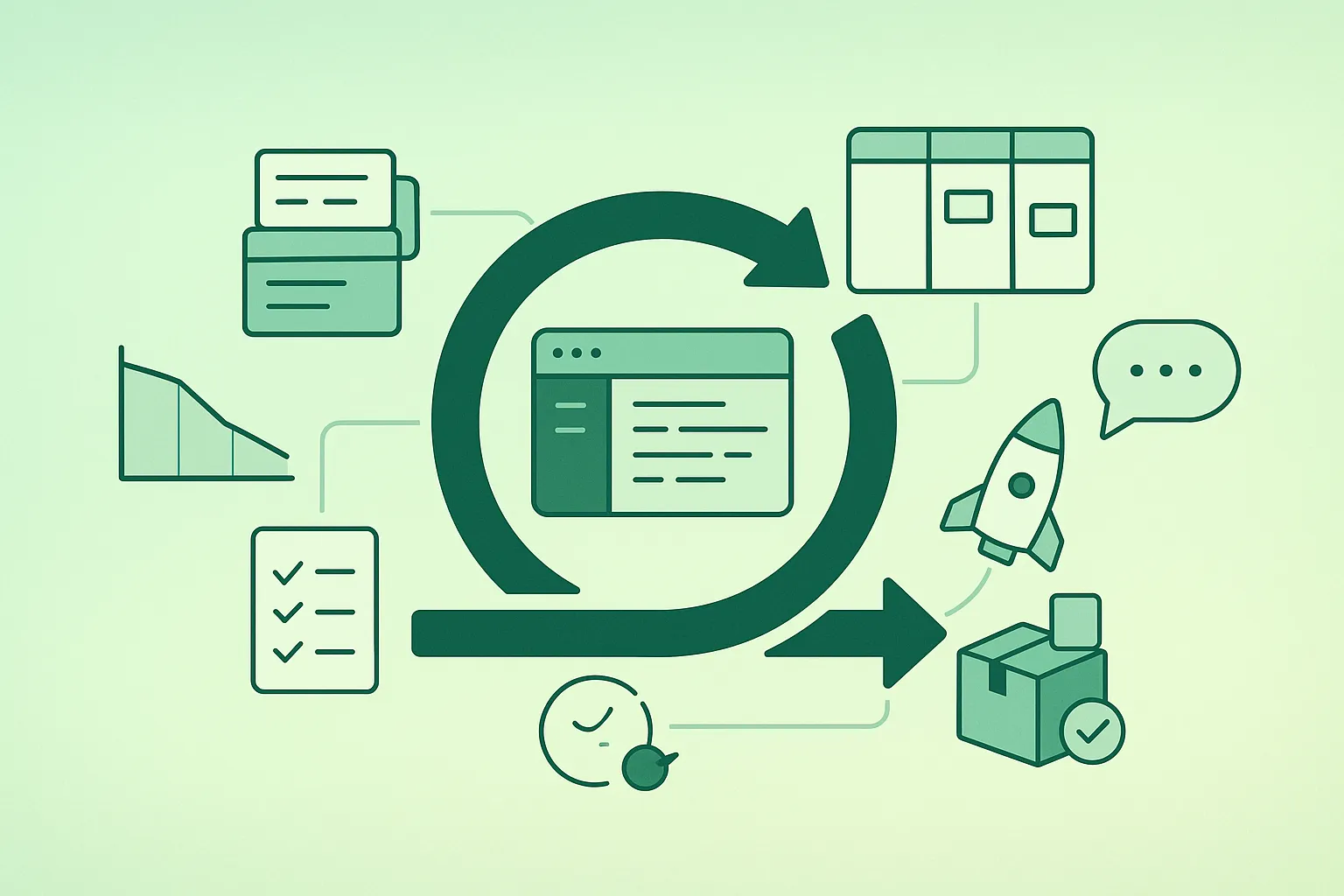
Agile is an approach to building software that focuses on delivering value in small increments, getting feedback quickly, and improving continuously. It’s not a rigid process and it’s not “no planning”. In practice, Agile teams create visibility (boards and backlogs), align on priorities, limit work in progress, ship frequently, and learn from real outcomes.
Agile in one line
Deliver something useful, learn from feedback, and adjust—repeatedly.
If you want the wider end-to-end delivery view (planning → build → test → release → maintenance), read the SDLC guide: Software Development Life Cycle (SDLC) Explained . For writing maintainable code inside Agile iterations, see: Clean Code Best Practices .
1. What Agile Is (And What It Isn’t)
Agile helps teams reduce risk by shortening the time between “idea” and “real feedback”. Instead of betting everything on a big plan, you deliver a small slice, learn, and iterate. That feedback can come from users, stakeholders, production metrics, or support tickets.
- Agile is: iterative delivery + fast feedback loops.
- Agile is: transparency in work and priorities.
- Agile is: continuous improvement (product + team + process).
- Agile is not: “no planning” or “no documentation”.
- Agile is not: micromanagement via standups, story points, or velocity targets.
Common misconception
If your team “does Scrum ceremonies” but still delivers late, ships buggy releases, and gets no stakeholder feedback, you’re doing Agile theater. Agile is defined by outcomes and learning—ceremonies are just tools.
2. Values and Principles (In Plain English)
Agile prioritizes outcomes and learning over rigid plans. The classic summary (often called the “Agile values”) can be read as:
- People and collaboration matter more than tools and process.
- Working software matters more than long documentation.
- Customer feedback matters more than locked scope.
- Responding to change matters more than following a plan.
In day-to-day work, Agile principles show up as practical behaviors: keep work items small, make progress visible, validate assumptions early, and invest in quality so change stays safe.

Practical tip
If you want to “be more Agile”, don’t add meetings first. Reduce batch size (smaller stories) and increase feedback frequency (more demos, earlier validation).
3. Scrum vs Kanban: Which to Use
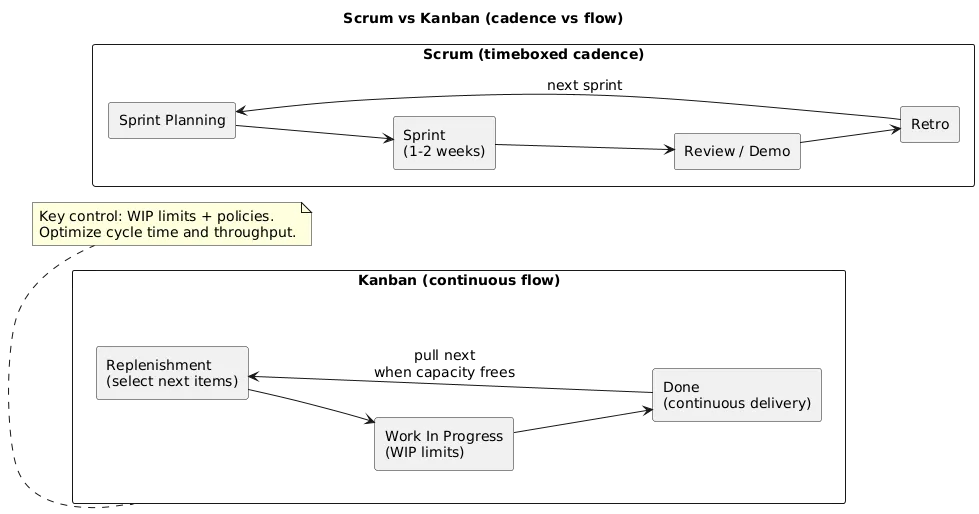
Scrum and Kanban are two popular ways to run Agile work. Both can work well—your choice should fit your work type (project vs flow), stakeholder cadence, and the amount of unplanned work.
| Topic | Scrum | Kanban |
|---|---|---|
| Cadence | Fixed-length sprints (often 1–2 weeks) | Continuous flow (no sprints required) |
| Planning | Sprint planning + sprint goal | Replenishment as capacity frees up |
| Flow control | Implicit (via sprint commitment) | Explicit WIP limits per workflow step |
| Best for | Work with a clear review/demo rhythm | Teams with frequent inbound/interrupt work |
| Key metrics | Forecasting via velocity (careful) | Cycle time, throughput, WIP |
Quick selection rule
If you need a predictable cadence for stakeholder demos, start with Scrum. If you handle frequent inbound work (support, ops, bugs) and want flow efficiency, start with Kanban (or hybrid: sprints + WIP limits).
4. Roles and Responsibilities
Agile works when ownership is clear. Titles vary by company, but the responsibilities are consistent: decide what matters most, build it with quality, and continuously improve how you work.
- Product Owner / Product Lead: prioritizes value, clarifies outcomes, owns backlog ordering.
- Delivery Team: cross-functional group that ships increments and owns quality.
- Scrum Master / Agile Coach: improves the system of work, removes blockers, protects focus.
- Stakeholders: provide constraints and feedback early (not only at the end).
Role smell
If the Product Owner is unavailable or decisions are constantly delayed, your team will accumulate ambiguity, overbuild, and ship the wrong thing. Agile needs fast decisions and fast feedback.
5. Core Artifacts: Backlog, Board, DoD
Agile artifacts are not paperwork. They are tools that create shared understanding and reduce hidden work. The minimum set most teams need: a backlog, a board, and clear definitions of “ready” and “done”.
- Product backlog: ordered list of work items that create value.
- Board: visual workflow (To Do → In Progress → Done), ideally including blockers.
- Definition of Done (DoD): shared quality bar (tests, review, docs, deploy, etc.).
- Definition of Ready (optional): what a story needs before it can be pulled into work.

Definition of Done template (copy/paste)
- Code reviewed (PR approved)
- Automated tests updated and passing
- Feature works for happy path + key edge cases
- Errors handled; logs are actionable (no secrets)
- Docs updated (if needed)
- Deployed to staging (at minimum) and verified
- Release notes updated (if user-visible)
6. Ceremonies (And Lightweight Alternatives)
Ceremonies exist to reduce risk: align quickly, detect problems early, and improve the team system. If a meeting doesn’t create a decision, a plan, or a learning—cut it down or remove it.
- Daily sync: coordinate work and unblock (not status reporting).
- Planning: agree on a goal and a realistic slice of work.
- Review/demo: show working software and get feedback from real stakeholders.
- Retrospective: improve process with 1–3 tracked actions.
- Refinement: keep upcoming backlog items clear, small, and testable.
Remote-friendly retro template
Start: one thing we should begin doing
Stop: one thing we should stop doing
Continue: one thing that’s working
Action: 1–3 owners + due dates
7. User Stories and Acceptance Criteria
User stories are a lightweight way to express value. The goal is not perfect text—it’s shared understanding, plus testable acceptance criteria to avoid rework.
Common story template:
As a <type of user>
I want <some capability>
So that <some benefit>
Add acceptance criteria (testable conditions). A practical format is “Given / When / Then”:
Acceptance criteria example
Given invalid credentials
When a user signs in
Then show an error and do not create a session
And log the attempt without storing the password
How to split stories (so they ship)
- Split by workflow step: create → view → edit → delete.
- Split by rule: simple case first, then complex edge cases.
- Split by user segment: admins first, then standard users.
- Split by interface: API first, UI later (or vice versa), as long as you can demo value.
8. Estimation: Story Points vs Time
Estimation is not about predicting the future perfectly—it’s about making trade-offs explicit and reducing uncertainty. The most reliable way to improve estimation is to reduce work item size.
- Story points: relative effort/complexity/uncertainty (team-specific).
- T-shirt sizes: XS/S/M/L for early discovery work.
- Time estimates: useful for coordinating external dates, but often inaccurate for complex work.
- Best practice: keep items small and remove unknowns via spikes/prototypes.
Velocity warning
If velocity becomes a target, it stops being a measure. Teams will inflate points and optimize the metric, not the outcome. Use it only for internal forecasting.
9. Backlog Refinement and Planning
Refinement is where Agile teams “buy down” risk before starting. It’s the difference between predictable delivery and constant spillover.
Refinement checklist
- Goal/value is clear (why are we doing this?)
- Acceptance criteria defined (testable)
- Dependencies and risks identified
- Story sized small enough to complete within your cadence
- Edge cases and constraints captured (security, compliance, performance)
Sprint planning checklist (Scrum)
- Sprint goal: one sentence describing outcome.
- Capacity: account for on-call, meetings, interrupts, and tech debt.
- Selection: pick work that supports the goal and fits capacity.
- Execution plan: identify first steps and likely risks.
Sprint goal template
This sprint we will <deliver outcome>
so that <user/stakeholder> can <benefit>
and we’ll measure success by <metric or observable signal>.
10. Useful Metrics (Without Gaming)
Metrics are useful when they help you improve the system. Use a small set, review them regularly, and avoid using them to rank individuals.
- Lead time: request → delivered (customer-facing responsiveness).
- Cycle time: started → done (flow efficiency).
- Throughput: items completed per time period (capacity signal).
- WIP: how much is in progress (predictor of cycle time).
- Quality signals: production defects, incidents, rollback frequency.
Metric rule
If a metric can be gamed, assume it will be. Pair metrics with qualitative context (customer feedback, incident notes, review outcomes).
11. Common Agile Pitfalls (And Fixes)
- Ceremony overload: too many meetings. Fix: shorten, timebox, and focus on decisions.
- No refinement: work enters execution unready. Fix: weekly refinement and story splitting.
- Overcommitment: constant spillover. Fix: plan by capacity; limit WIP; keep stories small.
- Invisible work: interrupts and bugs not tracked. Fix: put all work on the board.
- Weak stakeholder feedback: demos without real decision-makers. Fix: invite users and owners.
- Quality as “later”: testing postponed. Fix: enforce DoD; invest in automation.
- Agile as control: standups become policing. Fix: keep daily sync about coordination and blockers.
12. Agile Team Checklist
- Priorities: one ordered backlog with clear ownership.
- Visibility: a board that reflects reality (including bugs/interrupts).
- Flow: explicit WIP limits or capacity planning to protect focus.
- Quality bar: a Definition of Done the team respects.
- Small items: stories split to reduce uncertainty.
- Feedback: regular demos with actionable feedback from stakeholders.
- Improvement: retros with 1–3 actions tracked to completion.
- Metrics: used to improve the system, not punish people.
13. FAQ: Agile Basics
Is Agile the same as Scrum?
No. Agile is a broader approach; Scrum is one framework teams use to apply Agile principles.
Do we need sprints to be Agile?
Not necessarily. Many teams use a Kanban-style flow and still operate Agile. What matters is delivery, feedback, and improvement.
How do we handle urgent work?
Make it visible on the board, reserve capacity, and set explicit policies for interrupts so they don’t silently destroy plans.
How long should a sprint be?
Common sprint lengths are 1–2 weeks. Shorter sprints create faster feedback but increase planning overhead.
What’s the fastest Agile improvement?
Put all work on the board, limit WIP, and run retros that produce specific actions you actually follow up on.
Key Agile terms (quick glossary)
- Backlog
- Ordered list of work items that deliver value.
- User story
- A short description of value from a user’s perspective plus acceptance criteria.
- Acceptance criteria
- Testable conditions that must be true for a story to be considered done.
- Definition of Done (DoD)
- Shared quality standard for “done” (tests, review, deploy, docs, etc.).
- WIP limit
- A cap on how many items can be in progress at once to improve flow.
- Lead time
- Time from request to delivery.
- Cycle time
- Time from starting work to completing it.
- Retrospective
- A regular meeting to improve how the team works, with actionable outcomes.
Worth reading
Recommended guides from the category.