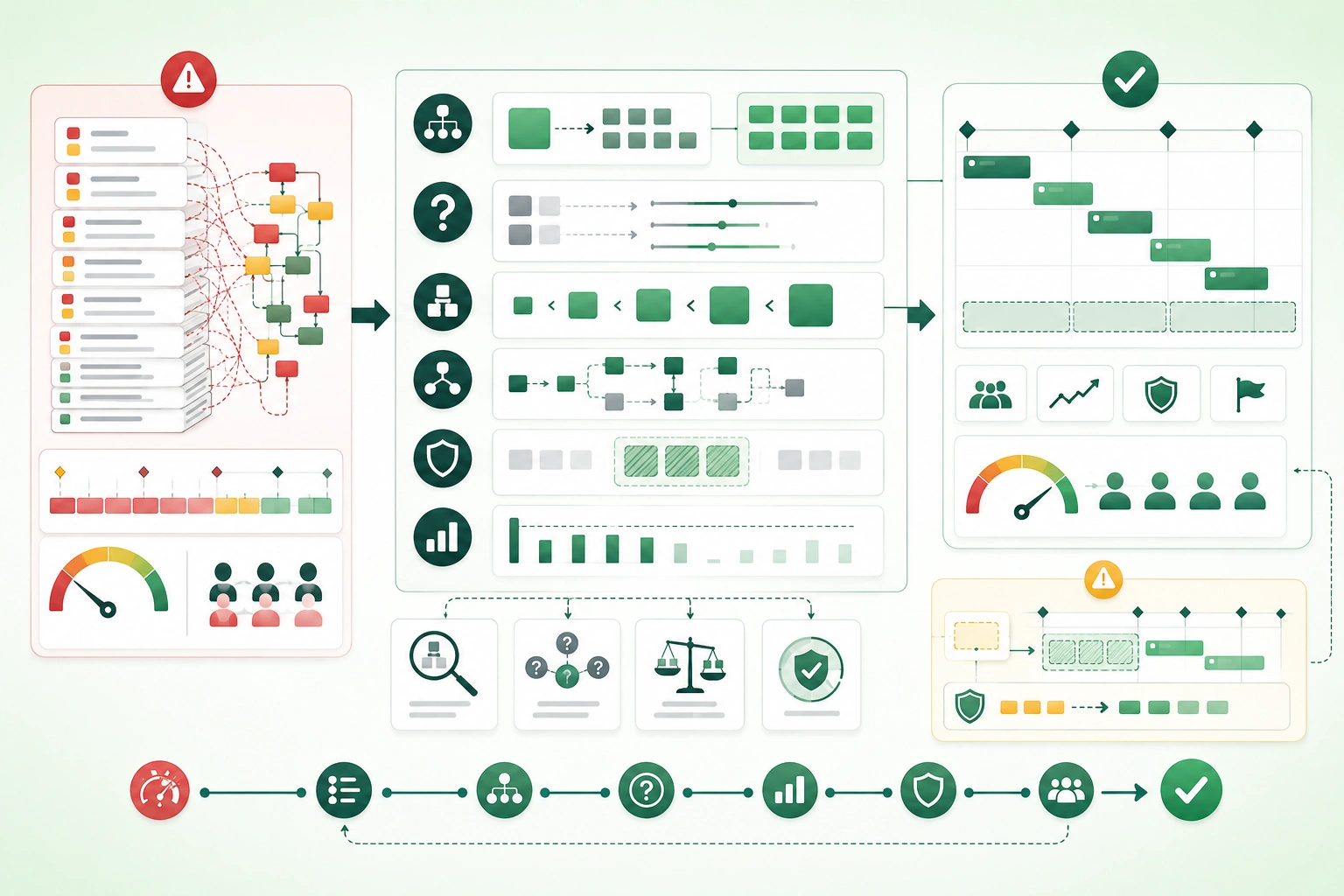
Software estimation becomes dangerous when a rough forecast is silently converted into a commitment.
A developer says:
Probably three days.A project plan records:
Delivery: Thursday.The estimate may have assumed:
requirements are stable

API behavior is understood

no migration is needed

review is immediate

tests are straightforward

nothing urgent interrupts the work
but the commitment now appears precise.
Better estimation separates:
scope
effort
uncertainty
calendar duration
capacity
confidence
commitment
Do not negotiate uncertainty away
If an estimate is larger than the desired deadline, the solution is not automatically to produce a smaller estimate. Change scope, sequencing, staffing, assumptions, or the deadline. The uncertainty still exists even when the number in the plan is reduced.
1. Treat estimates as forecasts, not promises
An estimate answers:
Given what we know now,
what outcome seems plausible?
A commitment answers:
What outcome are we prepared
to organize work around?
They are related, but they are not identical.
Effort is not duration
A task may require:
8 hours of engineering effortwhile taking:
4 calendar daysbecause it waits for:
review

test environment

vendor response

product clarification
Duration is not commitment
Even if expected duration is:
4 dayscommitting to:
exactly Fridaymay require additional confidence or contingency.
State assumptions with estimates
Estimate:
3 to 5 working days

Assumptions:
- API schema is final
- no data migration
- one reviewer available
- existing auth flow reused
If an assumption changes, the estimate should be reconsidered.
2. Make uncertainty visible
Software estimation uncertainty flow (diagram)
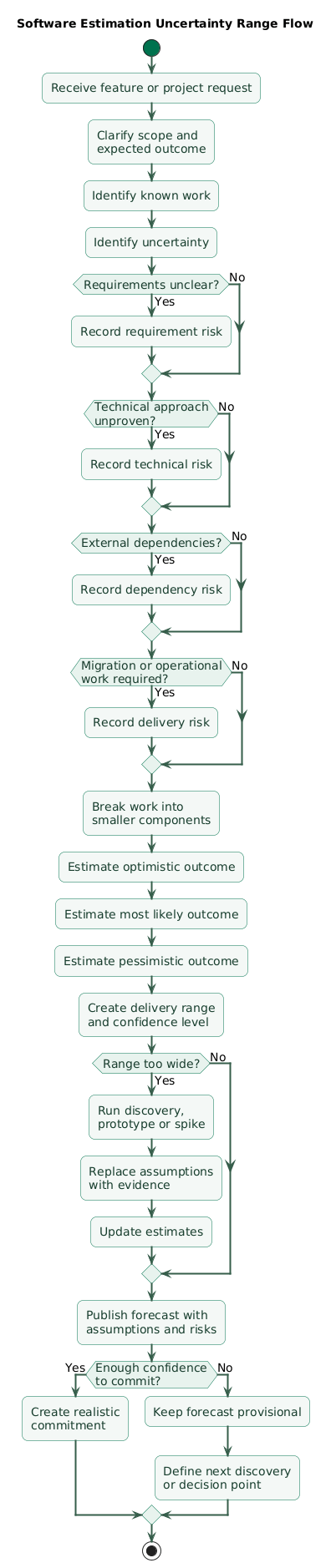
Uncertainty usually comes from several sources.
Requirement uncertainty
What behavior is actually wanted?Technical uncertainty
Will the proposed design work?Dependency uncertainty
Will another team, service,
vendor, or environment be ready?
Execution uncertainty
What defects or integration
problems will appear?
Operational uncertainty
Does rollout require migration,
monitoring, support, or rollback work?
Use uncertainty as information
Compare:
Feature A:
4 to 5 days
with:
Feature B:
2 to 10 days
The second feature may have a lower expected effort but much higher planning risk.
Discovery can reduce the range
before prototype:
2 to 10 days

after prototype:
5 to 7 days
Spending time to reduce uncertainty can improve planning even when it adds short-term work.
3. Define what done actually includes
Teams commonly underestimate by estimating:
code writteninstead of:
change safely deliveredDefinition of done may include
implementation

unit tests

integration tests

code review

documentation

migration

feature flag

deployment

monitoring

cleanup
Example
A new field may sound like:
Add preferredLanguage
to the user object.
Actual work may include:
schema change

migration

API update

validation

UI form

translations

backfill

tests

documentation

analytics change
Clarify exclusions
Included:
API and database support

Excluded:
admin UI
historical backfill
mobile client update
This prevents two people from agreeing on the estimate while imagining different scopes.
4. Break large work into estimable pieces
Large tasks hide uncertainty.
Weak:
Build team permissions.

Estimate:
2 weeks.
Better decomposition:
permission model

database schema

authorization service

API enforcement

admin UI

migration

audit logs

tests

rollout
Break work by observable responsibility
Useful boundaries include:
data

backend

frontend

integration

migration

operations
Do not decompose into meaningless microtasks
create class
add getter
add setter
rename variable
does not necessarily improve estimation.
Decompose until unknowns become visible
If:
authorization integrationremains highly uncertain, isolate it as:
technical spike
or
discovery task
Separate discovery from delivery
Discovery:
Can existing permission service
support resource-level roles?

Delivery:
Implement resource-level roles
using confirmed approach.
This avoids pretending that unresolved design work is routine implementation.
5. Use ranges and three-point estimates
A single estimate:
5 dayshides whether the engineer means:
almost certainly 5

or

maybe 2, maybe 12
Three-point estimate
Optimistic:
3 days

Most likely:
5 days

Pessimistic:
9 days
Optimistic case
Ask:
If things go unusually smoothly,
what is a credible lower bound?
Most likely case
What outcome best represents
normal execution?
Pessimistic case
What happens if realistic
known risks occur?
Do not use:
meteor destroys datacenteras the pessimistic case.
Use the spread as a risk signal
2 / 3 / 4 daysindicates a relatively understood task.
2 / 5 / 15 daysindicates a task that deserves discovery or risk reduction.
6. Calibrate with historical delivery data
People are poor at remembering how often work:
waited in review

failed integration

expanded in scope

was interrupted
Historical data provides a reality check.
Useful data
cycle time

lead time

throughput

completed work per period

review delay

deployment delay
Use comparable work
Example:
Recent small API additions:

3 days
4 days
4 days
6 days
8 days
A new similar change estimated at:
1 daydeserves investigation.
Do not blindly average unrelated work
Compare:
similar technology

similar integration depth

similar team

similar deployment process
Use distributions rather than only averages
If most tasks finish in:
3 to 5 daysbut a meaningful minority take:
10 to 15 daysthat long tail matters for commitments.
7. Use relative estimation carefully
Relative estimation asks:
How large is this
compared with work we understand?
Reference work
Adding a normal CRUD endpoint:
reference size 3
Then another task can be judged as:
smaller

similar

roughly twice as complex
Story points can help within one stable team
They can combine:
effort
complexity
uncertainty
Avoid converting points directly into hours
1 point = 4 hoursremoves much of the benefit of relative estimation.
Do not compare team velocities
Team A:
40 points

Team B:
25 points
does not prove Team A produces more value.
Planning poker can expose assumptions
If estimates are:
3
3
3
13
the important result is not the average.
Ask why one person sees much more risk.
8. Estimate dependencies separately from coding effort
A task may require:
4 hours of codingand:
10 days of calendar timebecause an external dependency controls the schedule.
Common dependencies
another team

third-party vendor

security review

production access

legal approval

test data

environment provisioning
Model dependency state
Ready

Expected by date

Unknown

Blocked
Do not hide dependency delays inside coding estimates
Report:
Engineering effort:
2 to 3 days

Calendar risk:
depends on vendor sandbox access
Integration points increase uncertainty
Every boundary can introduce:
schema mismatch

authentication problem

environment difference

retry behavior

rate limit

unexpected error
9. Plan with real capacity, not calendar hours
Software estimation breakdown and capacity model (diagram)
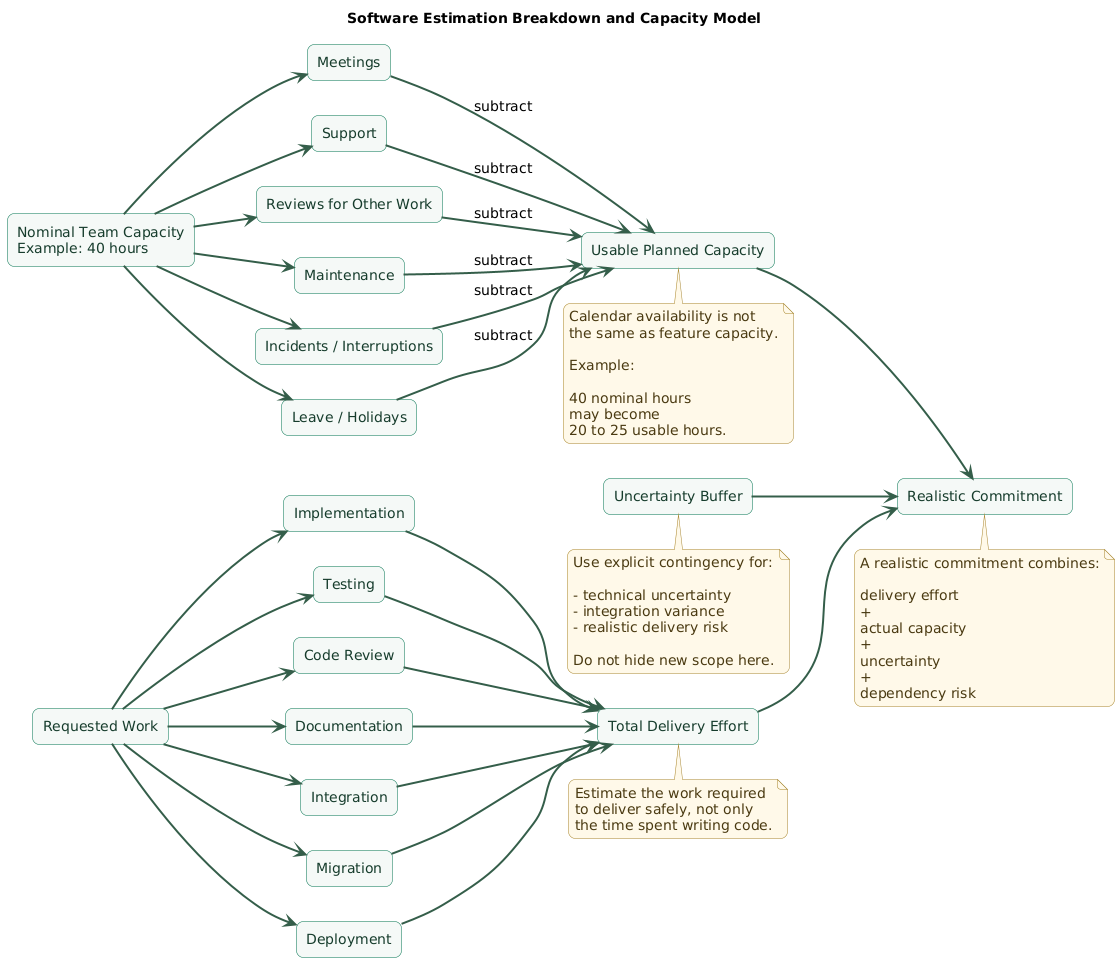
A developer working five eight-hour days has:
40 calendar working hoursbut not:
40 feature-development hoursCapacity is consumed by
meetings

code reviews

support

incidents

maintenance

planning

communication

context switching
Example
Nominal:
40 hours

Meetings:
6

Support:
4

Reviews:
4

Maintenance:
3

Usable planned capacity:
23 hours
Committing:
40 hours of feature workin that week guarantees pressure before anything unexpected happens.
Account for leave
vacation

public holidays

training

appointments
Do not assume adding people scales linearly
Two developers do not necessarily turn:
10 daysinto:
5 daysbecause work may be sequential or require coordination.
Limit simultaneous commitments
Starting:
10 tasksdoes not make the team finish:
10 tasks soonerwhen the same people must context-switch among them.
10. Use buffers for uncertainty, not hidden padding
Hidden padding looks like:
Engineer believes:
4 days

Engineer reports:
8 days
because estimates are routinely negotiated downward.
This destroys transparency.
Prefer explicit contingency
Base expected work:
12 days

Integration uncertainty:
3 days

Release contingency:
2 days
Not every task needs the same buffer
A routine change may have:
small uncertaintywhile a first integration with an undocumented vendor may require:
large uncertainty allowanceKeep project-level contingency where useful
Instead of padding:
every task by 30%a team can maintain:
visible delivery contingencybased on historical variability.
Buffers should protect uncertainty, not scope creep
New requirements are:
new scopenot:
estimate variance11. Treat fixed deadlines as scope decisions
Suppose the estimate is:
6 to 9 weeksbut the date is:
4 weeks awayThe estimate does not become:
4 weeksbecause the deadline exists.
Change one of the variables
scope

date

resources

quality constraints

delivery sequence
Scope is often the safest variable
Must have:
authentication
core workflow
payment

Later:
advanced reporting
bulk import
custom themes
Use milestone slicing
Week 2:
internal prototype

Week 4:
minimum usable release

Week 6:
secondary workflows

Week 8:
polish and automation
Do not trade away invisible safety work casually
Cutting:
testing
monitoring
rollback
security review
may make the delivery date appear achievable while increasing the chance of production failure.
12. Attach confidence to commitments
Compare:
Delivery:
September 18
with:
Current forecast:
September 16 to 22

Confidence:
medium

Main risks:
vendor API behavior
migration duration
The second statement is more useful for planning.
Simple confidence levels
High:
known implementation
few dependencies
similar work completed before

Medium:
some unknowns
manageable dependencies

Low:
requirements or technical path
still unresolved
Confidence should improve over time
Idea:
low confidence

After technical discovery:
medium confidence

After integration proven:
high confidence
Do not communicate low confidence as a hard date
Instead use:
range

assumptions

decision point

next re-estimation date
13. Re-estimate when information changes
Commitment and re-estimation flow (diagram)
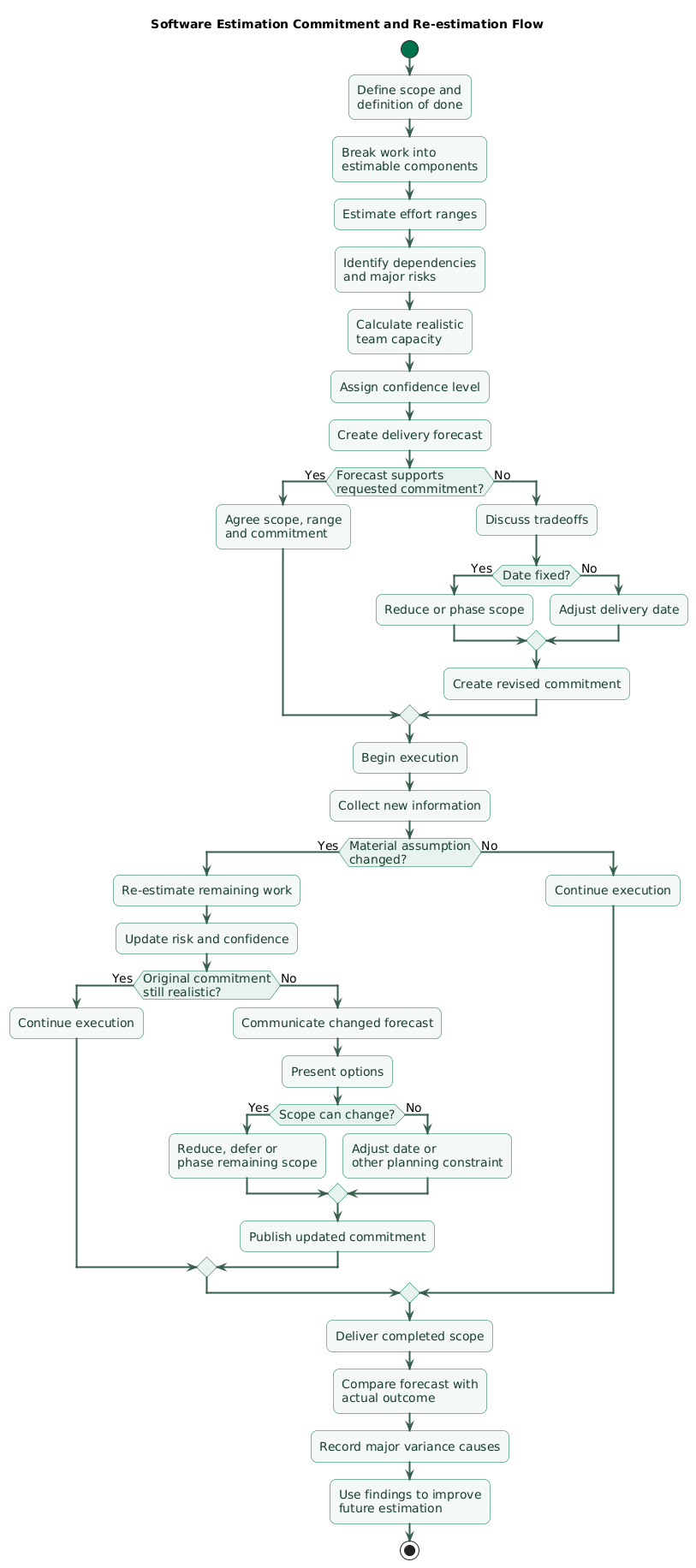
An estimate is based on available information.
When information changes:
the estimate should change tooValid re-estimation triggers
requirement changed

integration differs from documentation

migration volume much larger

critical dependency delayed

prototype disproved design

production constraint discovered
Re-estimation is not failure
Refusing to update a forecast after reality changes does not make the original estimate more correct.
Communicate early
Weak:
Deadline is tomorrow.
We need another week.
Better:
Integration discovery increased
the likely duration from 5 to 8 days.

We can either:
- move the date by 3 days
- remove export support
- ship export behind a flag later
Always pair bad news with decision options
new forecast

cause

impact

available tradeoffs
14. Learn from estimate error without weaponizing it
Record:
estimated range

actual duration

major variance cause
Look for patterns
testing repeatedly omitted

vendor integrations underestimated

reviews add two days

migrations have long tails

support interrupts every sprint
Improve the system
If reviews repeatedly delay work:
improve reviewer availabilityrather than simply:
add two days to every estimateDo not rank engineers by estimate accuracy
That encourages:
defensive padding

easy-task selection

hidden uncertainty

reluctance to update forecasts
Evaluate calibration at team level
Ask:
Do our 80% confidence forecasts
finish within the stated range
roughly as often as expected?
Track causes, not blame
scope growth

dependency delay

technical unknown

interruptions

quality issue
Those categories can improve future planning.
15. Copy/paste software estimation checklist
Software estimation checklist

Before estimating
- What problem are we solving?
- Is the requested behavior clear?
- Is acceptance criteria available?
- Are major unknowns identified?
- Are stakeholders aligned on scope?
- Is there a fixed date?
- Is there a fixed budget?
- Is there a fixed team?

Definition of done
- Implementation included.
- Tests included.
- Code review included.
- Documentation included.
- Migration included.
- Deployment included.
- Monitoring included.
- Rollback included.
- Cleanup included.
- Feature flag work included where needed.

Scope
- Included behavior listed.
- Excluded behavior listed.
- Nice-to-have work separated.
- Future work separated.
- Assumptions recorded.
- Constraints recorded.

Breakdown
- Split frontend work.
- Split backend work.
- Split database work.
- Split integration work.
- Split migration work.
- Split testing work.
- Split deployment work.
- Split documentation work.
- Split operational work.

Unknowns
- Requirement unknowns identified.
- Technical unknowns identified.
- Dependency unknowns identified.
- Data unknowns identified.
- Security unknowns identified.
- Performance unknowns identified.
- Deployment unknowns identified.

Discovery
- Use spike for unresolved technical risk.
- Timebox discovery.
- Record findings.
- Re-estimate after discovery.
- Do not pretend discovery result is known before investigation.

Estimate type
- Effort estimate?
- Calendar duration?
- Delivery forecast?
- Commitment?
- Make the distinction explicit.

Ranges
- Avoid false single-point precision.
- Give lower plausible bound.
- Give likely outcome.
- Give upper plausible bound.
- Explain major reasons for spread.
- Increase range when uncertainty is high.

Three-point estimate
- Optimistic case realistic.
- Most likely case realistic.
- Pessimistic case based on plausible risks.
- Do not use impossible best case.
- Do not use catastrophe as ordinary worst case.
- Use spread as uncertainty signal.

Confidence
- High confidence for familiar work.
- Medium confidence for manageable unknowns.
- Low confidence for unresolved design.
- State confidence explicitly.
- Explain what would increase confidence.
- Update confidence after discovery.

Historical calibration
- Compare with similar completed work.
- Review cycle-time distribution.
- Review throughput.
- Review integration history.
- Review migration history.
- Review incident interruption rate.
- Review typical code-review delay.
- Review deployment delay.

Reference tasks
- Maintain examples of small work.
- Maintain examples of medium work.
- Maintain examples of large work.
- Prefer recent comparable work.
- Avoid comparing unrelated technology.

Story points
- Use for relative sizing if team benefits.
- Keep point meaning team-specific.
- Do not compare velocity across teams.
- Do not convert points mechanically into hours.
- Recalibrate reference stories periodically.
- Discuss large estimation disagreements.

Planning poker
- Estimate independently first.
- Reveal together.
- Discuss high and low estimates.
- Ask which assumptions differ.
- Re-estimate after discussion.
- Do not average disagreement without understanding it.

Dependencies
- List external teams.
- List vendor dependencies.
- List approval dependencies.
- List environment dependencies.
- List data dependencies.
- Record dependency owner.
- Record readiness.
- Separate dependency wait from engineering effort.

Integration risk
- Authentication understood?
- API documented?
- Sandbox available?
- Rate limits known?
- Error behavior known?
- Test data available?
- Version compatibility known?
- Timeout behavior known?
- Retry semantics known?

Database
- Schema change?
- Migration?
- Backfill?
- Index?
- Data cleanup?
- Production volume known?
- Lock risk?
- Rollback strategy?
- Mixed-version compatibility?

Testing
- Unit tests.
- Integration tests.
- End-to-end tests.
- Regression tests.
- Performance tests if needed.
- Security tests if needed.
- Manual verification if needed.
- Test environment availability.

Review
- Reviewer available?
- Specialist reviewer needed?
- Security review required?
- Design review required?
- Typical review delay included?
- Rework after review considered?

Documentation
- README update?
- API documentation?
- Runbook?
- Architecture document?
- ADR?
- Migration guide?
- Release notes?

Deployment
- Deployment procedure?
- Feature flag?
- Staged rollout?
- Migration order?
- Monitoring?
- Support handoff?
- Rollback?
- Cleanup after rollout?

Capacity
- Start with real people.
- Subtract leave.
- Subtract public holidays.
- Subtract meetings.
- Subtract support.
- Subtract code review.
- Subtract maintenance.
- Subtract incident duty.
- Subtract recurring operational work.
- Preserve some capacity for interruptions.

Nominal capacity
- Do not assume 8 hours per day of feature work.
- Do not assume every team member has equal availability.
- Do not assume adding people gives linear acceleration.
- Do not assume specialists are interchangeable.

Context switching
- Count simultaneous work.
- Limit work in progress.
- Avoid planning every person at 100%.
- Account for interrupt-heavy roles.
- Protect focus time.

Buffers
- Use for uncertainty.
- Make contingency visible.
- Base on risk or historical variability.
- Do not hide arbitrary padding inside every task.
- Do not use buffer to absorb new scope.
- Reassess buffer after uncertainty reduces.

Deadlines
- Is date externally fixed?
- Why is it fixed?
- What happens if it moves?
- Which scope is mandatory?
- Which scope can move later?
- Which quality constraints cannot be traded away?
- Can rollout be phased?

Fixed date
- Reduce scope first.
- Sequence must-have work first.
- Use feature flags.
- Deliver thin vertical slice.
- Delay secondary features.
- Preserve testing and recovery requirements.
- Communicate confidence.

Fixed scope
- Allow date to move if necessary.
- Identify critical path.
- Protect dependencies.
- Communicate range.
- Re-estimate as work progresses.

Critical path
- Identify sequential dependencies.
- Identify long approvals.
- Identify environment waits.
- Identify migrations.
- Identify external integrations.
- Optimize the actual schedule bottleneck.

Milestones
- Define early proof point.
- Define integration milestone.
- Define minimum usable release.
- Define production-readiness milestone.
- Avoid treating every milestone as final scope.

Commitment
- Estimate reviewed.
- Capacity reviewed.
- Dependencies reviewed.
- Risks recorded.
- Confidence stated.
- Scope understood.
- Stakeholders know assumptions.
- Commitment includes contingency where needed.

Communication
- Give range.
- Give confidence.
- Give assumptions.
- Give major risks.
- Give next decision point.
- Give tradeoff options.
- Avoid unexplained precise dates.

Status updates
- What changed?
- What was learned?
- Is forecast still valid?
- Did scope change?
- Did dependency change?
- Did confidence increase or decrease?
- Is decision required?

Re-estimation
- Re-estimate after requirement change.
- Re-estimate after technical discovery.
- Re-estimate after dependency delay.
- Re-estimate after scope growth.
- Re-estimate after major defect.
- Re-estimate after migration findings.
- Communicate updated forecast early.

Do not anchor forever
- Early estimate can change.
- Discovery can narrow range.
- New risks can widen range.
- A forecast is not invalid because it evolves.
- Refusing to update does not increase accuracy.

Overcommitment warning signs
- Every person planned at 100%.
- No allowance for support.
- No allowance for reviews.
- No allowance for incidents.
- Single-point estimates for uncertain work.
- Dependencies assumed ready.
- Scope still undefined.
- Estimates repeatedly negotiated downward.
- Deadline chosen before discovery.
- Testing treated as optional.
- Several projects run simultaneously.

Historical review
- Store estimate range.
- Store actual duration.
- Record major variance cause.
- Look for systematic omissions.
- Look for long-tail work.
- Look for dependency patterns.
- Look for review delays.
- Look for recurring interruptions.

Calibration
- Improve team forecasting.
- Do not score individuals by estimate accuracy.
- Avoid rewarding padding.
- Avoid punishing honest uncertainty.
- Compare similar categories.
- Use distributions, not only averages.

Variance categories
- Scope change.
- Requirement ambiguity.
- Technical discovery.
- Dependency delay.
- Environment issue.
- Review delay.
- Test failure.
- Production issue.
- Support interruption.
- Underestimated complexity.

Process improvement
- Fix recurring bottlenecks.
- Automate repetitive setup.
- Improve test environments.
- Improve dependency ownership.
- Reduce review queues.
- Improve documentation.
- Improve observability.
- Reduce work in progress.

Final estimate review
- Is the scope explicit?
- Is done clearly defined?
- Has the work been decomposed?
- Are unknowns visible?
- Are dependencies identified?
- Is testing included?
- Is review included?
- Is migration included?
- Is deployment included?
- Is operational work included?
- Is real team capacity known?
- Are interruptions considered?
- Is the estimate a range where appropriate?
- Is confidence stated?
- Are assumptions documented?
- Is historical data available?
- Is contingency explicit?
- Is the deadline fixed for a real reason?
- Can scope move if date cannot?
- Is the critical path understood?
- Is re-estimation expected after discovery?
- Would stakeholders understand that this is a forecast rather than a guarantee?
16. FAQ
Why are software estimates so difficult?
Software work contains uncertainty in requirements, design, integration, testing, dependencies, data, and deployment. Early estimates are made before many of those unknowns have been resolved.
Should software estimates be ranges instead of single numbers?
Often yes. A range communicates uncertainty that a single number hides. Pair the range with assumptions and confidence so stakeholders understand why it may move.
What is a three-point estimate?
It records an optimistic, most likely, and pessimistic outcome. The method is useful because the spread makes uncertainty visible and encourages discussion of what could make the work easier or harder.
Are story points useful?
They can be useful for relative sizing inside a stable team. They are less useful when converted mechanically into hours or used to compare productivity between teams.
How much team capacity should be committed?
Use historical reality rather than nominal working hours. Subtract meetings, reviews, support, leave, maintenance, incidents, and other recurring work, and preserve some capacity for normal interruptions.
What should happen when a deadline is shorter than the estimate?
Discuss scope, sequencing, staffing, assumptions, or the deadline. If the date genuinely cannot move, reducing scope is usually safer than simply declaring that the same work will now take less time.
When should a team re-estimate?
Re-estimate when material information changes, such as a new requirement, unexpected integration behavior, dependency delay, migration discovery, major defect, or proof that the original technical approach will not work.
Key terms (quick glossary)
- Estimate
- A forecast of likely effort, duration, or delivery outcome based on the information currently available.
- Commitment
- A planning promise or agreed delivery target based on estimates, capacity, risk, scope, and organizational decisions.
- Effort
- The amount of active work required to complete a task, distinct from the calendar time the task remains in progress.
- Duration
- The elapsed calendar time from work start to completion, including waits, dependencies, review, and other delays.
- Three-point estimate
- An estimation technique that records optimistic, most likely, and pessimistic outcomes to expose uncertainty.
- Confidence level
- A qualitative or quantitative statement about how strongly current evidence supports an estimate or delivery range.
- Cycle time
- The elapsed time between work beginning and work reaching a defined completed state.
- Lead time
- The elapsed time between a request being made and the requested work being delivered.
- Throughput
- The number of work items completed during a given period.
- Story point
- A relative unit some teams use to compare work size, complexity, and uncertainty without directly expressing hours.
- Capacity planning
- The process of determining how much work a team can realistically accept after accounting for availability and recurring responsibilities.
- Contingency buffer
- Explicit time or capacity reserved to absorb realistic uncertainty and variability.
- Critical path
- The sequence of dependent activities that determines the earliest possible completion date of a larger body of work.
- Technical spike
- A timeboxed investigation used to reduce uncertainty about a technical approach before committing to full implementation.
- Reference task
- Previously completed or well-understood work used as a comparison point for relative estimation.
- Overcommitment
- Accepting more scope or tighter delivery promises than realistic capacity and uncertainty support.
Worth reading
Recommended guides from the category.