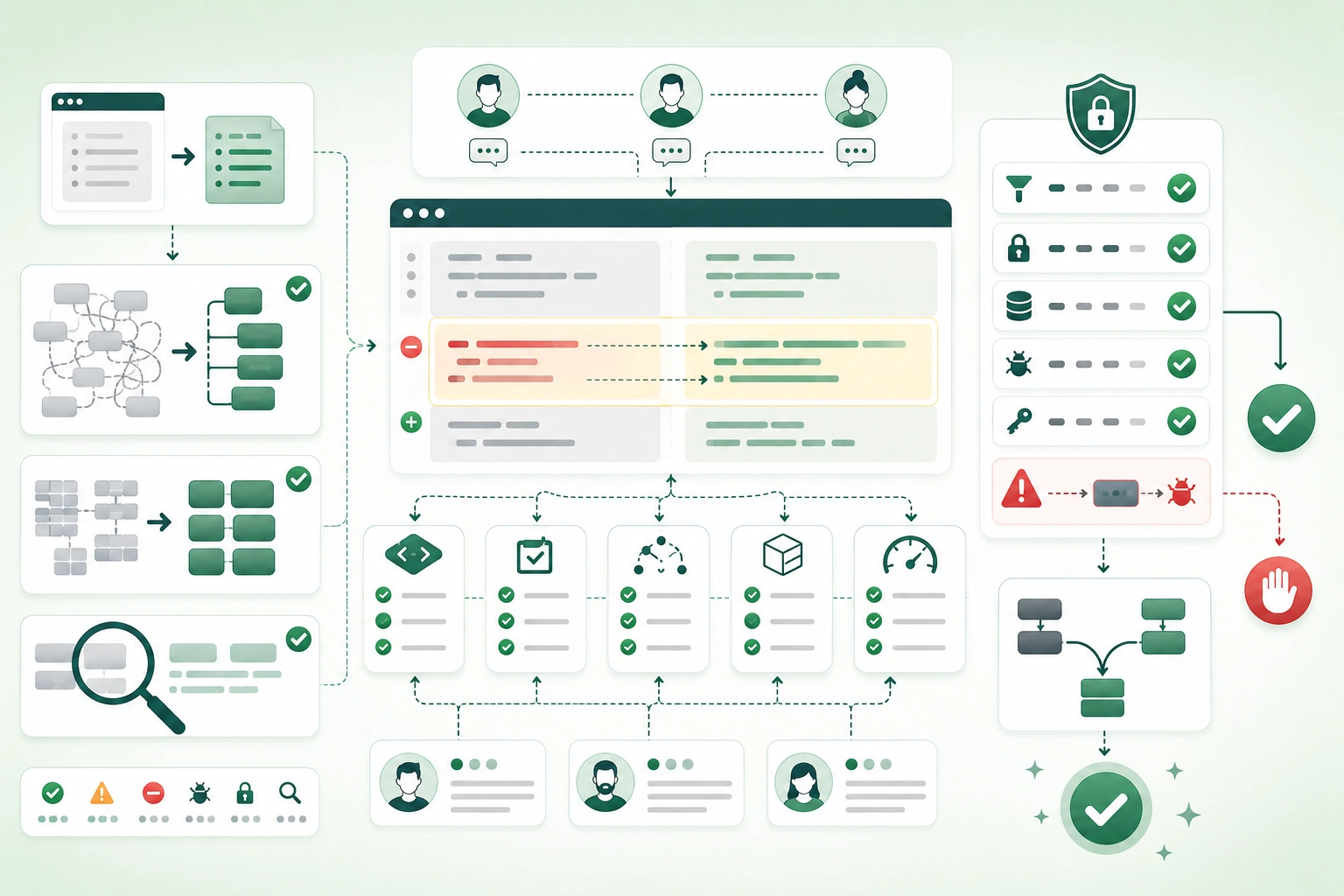
Code review fails when it becomes a ritual:
open pull request
skim diff
comment on naming
approve
A useful review asks a more important question:
What could go wrong
because of this change?
That includes:
incorrect behavior

security weakness

data corruption

broken compatibility

poor maintainability

performance regression

deployment surprise
A small team cannot spend hours reviewing every five-line change, so the objective is not maximum ceremony.
The objective is:
apply reviewer attention
where the risk is highest
Review from the outside in
Start with the problem, expected behavior, and deployment impact. Then inspect implementation details. A reviewer who begins at line one of the diff without understanding the change can spend ten minutes on naming while missing a broken authorization boundary.
1. Review risk, not just code style
Small-team code review workflow (diagram)
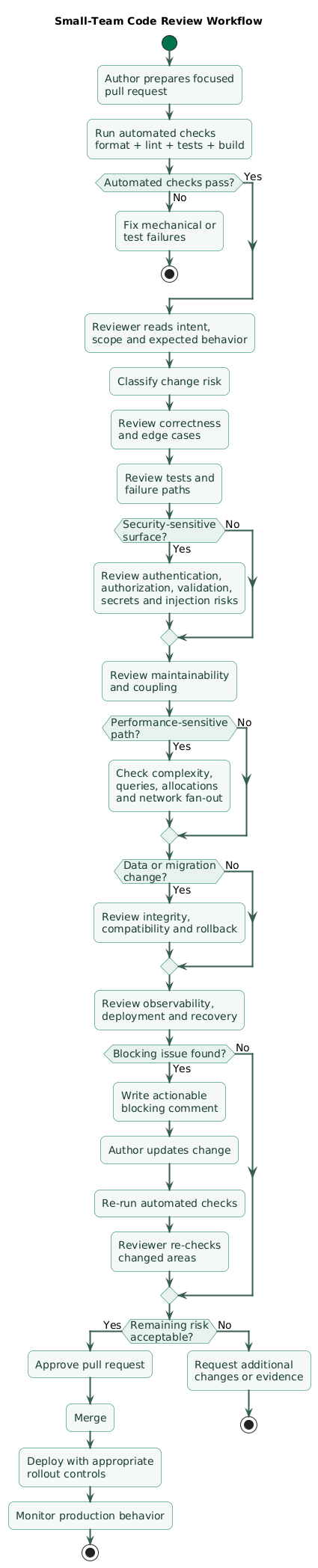
Human review is expensive.
Use automation for things machines are good at:
formatting

linting

type checking

unit tests

static analysis

dependency scanning

build verification
so humans can focus on:
intent

behavior

risk

architecture

security

operations
Review priorities
A useful order is:
1. Is the change necessary and correctly scoped?

2. Is the behavior correct?

3. Is it safe?

4. Are failure paths handled?

5. Are tests meaningful?

6. Will the code remain understandable?

7. Can it be deployed and rolled back safely?
Do not optimize for comment count
Ten comments about punctuation are not better than one comment that catches:
missing authorization checkApproval means acceptable risk
It does not mean:
I would have written
every line the same way
2. Check intent and pull request scope first
Before reviewing code, understand:
What problem is being solved?

What should change?

What should not change?

How will users notice?

How will operators notice?
Good pull request description
Problem:
Expired invitations can still be accepted.

Change:
Reject invitations after expiresAt.

Behavior:
Return 410 for expired invitations.

Tests:
Added before / at / after expiry cases.

Deployment:
No migration required.
Scope creep is a review problem
A bug fix should not casually include:
framework upgrade

database redesign

unrelated formatting

renaming 50 files
unless those changes are necessary.
Ask whether the diff is reviewable
A large change may be correct but difficult to verify.
Consider splitting:
mechanical rename

schema migration

behavior change

cleanup
into independently understandable pieces.
Check generated files separately
If a diff includes:
generated lock file

compiled bundle

generated client
focus on the source change responsible for it while still checking for unexpected dependency or artifact changes.
3. Verify correctness and edge cases
Start with the happy path:
Does the intended user action work?Then immediately look at boundaries.
Common edge cases
null

missing value

empty collection

zero

negative value

maximum size

duplicate input

already deleted item

expired state

concurrent update
Check state transitions
Suppose:
Pending -> Approvedis valid.
Ask whether:
Cancelled -> Approvedis accidentally possible.
Check failure behavior
If a database operation fails halfway through:
what has already changed?Check return semantics
Review changes from:
nullto:
empty objector:
falseto:
exceptionbecause callers may depend on the old contract.
Look for hidden behavior changes
changed ordering

changed default

changed timeout

changed rounding

changed timezone

changed case sensitivity
4. Review the tests as carefully as the implementation
A passing test suite does not prove the new behavior is tested.
Ask what new behavior the test proves
Weak:
assert response != nullStronger:
given expired invitation

when accept is requested

then status is 410

and membership is not created
Review positive and negative cases
valid input succeeds

invalid input fails

unauthorized caller fails

dependency failure is handled

no unwanted side effect occurs
Check boundary tests
For:
expiresAttest:
before expiry

exactly at expiry

after expiry
Tests should not simply reproduce implementation
If production code calculates:
x * 1.2and the test calculates:
expected = x * 1.2using the same logic, both may contain the same mistake.
Avoid brittle implementation tests
Prefer:
observable resultover:
private method called
exactly three times
unless the interaction itself is important.
Check regression protection
A bug fix should usually include a test that would fail:
before the fixand pass:
after the fix5. Perform a focused security pass
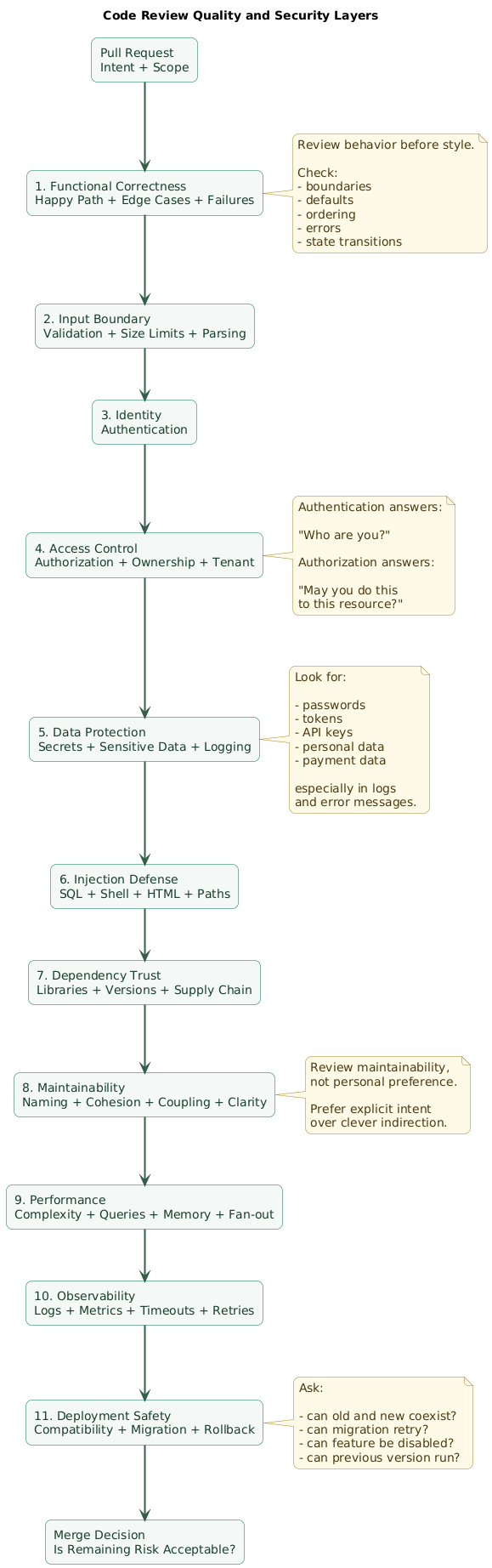
Code review quality and security layers (diagram)
Authentication
Does the code correctly identify the caller?
Authorization
More importantly:
May this caller perform
this action on this resource?
Do not confuse:
authenticatedwith:
authorizedInput validation
Treat:
HTTP input
message payload
file
webhook
CLI input
third-party response
as untrusted until validated.
Injection
Look for dynamic construction of:
SQL

shell command

HTML

LDAP query

path

template expression
from untrusted input.
Parameterized database access
Prefer:
query parametersover:
string concatenationShell execution
Prefer process APIs with separate arguments rather than:
"command " + userInputSensitive logging
Check whether new logs contain:
password

token

session ID

API key

payment data

personal information
Secrets
Reject committed:
credentials

private keys

production tokens
Dependency changes
A one-line import can introduce:
new transitive dependencies

new network behavior

new license obligations

new supply-chain risk
Review why the dependency is needed.
6. Treat data and migrations as high-risk changes
Application code can be rolled back.
Corrupted production data may be much harder to repair.
Review schema migrations explicitly
Ask:
Is migration backward compatible?

Will old application instances still work?

Does it lock a large table?

Does it rewrite every row?

Can it be retried?

Can it be rolled back?
Expand before contract
Safer migration pattern:
add new field

deploy compatible code

backfill

switch reads

stop old writes

remove old field later
Check data constraints
Application validation:
email must be uniquemay not be enough under concurrency.
A database uniqueness constraint may still be required.
Review transactions
If code changes:
transaction start

commit

rollback
inspect partial-failure behavior carefully.
Backfills need operational review
A script that updates:
40 million rowsdeserves review for:
batching

retry

progress

load

idempotency

restart behavior
7. Review for maintainability, not personal taste
Avoid:
I prefer this stylewhen both approaches are clear and consistent.
Review naming
Names should communicate:
domain meaning

ownership

side effects

units
Compare:
process()with:
reserveInventory()Review function responsibility
A function that:
validates request

calculates price

writes database

sends email

formats response
may be difficult to test and change.
Review abstraction level
Watch for:
giant functions

deep call chains

unnecessary interfaces

wrapper around wrapper

premature generic framework
Duplication is contextual
Two similar lines do not automatically require abstraction.
Ask:
Will these behaviors
change for the same reason?
Prefer explicit over clever
Code that saves:
four linesbut takes:
five minutes to understandmay be a poor maintenance tradeoff.
8. Look for expensive operations where scale matters
Not every pull request needs a performance investigation.
Look deeper when changes touch:
large datasets

hot request path

database queries

nested loops

serialization

image processing

network fan-out
Watch for N+1 queries
load users

for each user:
    load orders
can produce:
1 + N queriesCheck repeated scans
for each item:
    list.contains(item)
can hide quadratic work when:
contains = O(n)Review allocation
Hot loops creating:
large temporary lists

strings

objects
may increase memory pressure.
Review network fan-out
One request that now calls:
30 downstream serviceshas different latency and failure characteristics.
Ask for measurement when risk is real
Useful evidence:
benchmark

query plan

load test

before / after profile
9. Review concurrency and ordering assumptions
Concurrency bugs often look correct in a local single-request test.
Check read-modify-write sequences
read balance

if balance sufficient:
    subtract amount

write balance
Two concurrent requests may both observe the same starting state.
Ask what protects the invariant
database lock?

atomic update?

transaction?

optimistic version?

distributed lock?
Check ordering
If code emits:
database update

event
ask whether:
event before commitand:
event after commithave different failure behavior.
Retries can duplicate side effects
A retryable operation should consider:
idempotencyAsync tasks need ownership
Review:
fire-and-forget task

detached future

background thread
for:
error handling

shutdown

cancellation

resource lifetime
10. Protect public contracts and compatibility
Public contracts include more than HTTP APIs.
API response

event schema

database schema

CLI output

config file

library method

file format
Check field removal
Removing:
user_namemay break unknown consumers.
Check type changes
"count": 5changing to:
"count": "5"is a breaking contract even if humans see the same value.
Check semantics
Keeping the field name but changing:
millisecondsto:
secondsis also breaking.
Review deprecations
Prefer:
add new behavior

support old behavior

migrate callers

remove later
when compatibility matters.
11. Check logs, metrics, timeouts, and failure visibility
Ask:
If this breaks in production,
how will we know?
Logs
Useful logs can include:
request ID

operation

resource ID

safe failure reason
without including secrets.
Metrics
New critical workflows may need:
success count

failure count

latency

retry count

queue depth
Timeouts
A new network call without a timeout can turn:
remote slownessinto:
resource exhaustionRetries
Review:
which failures are retryable?

how many attempts?

what backoff?

is operation idempotent?
Alerts
Not every feature needs a new alert.
But a new critical dependency should have an operational owner and a detection strategy.
12. Review deployment and rollback safety
A change can pass every test and still be risky to release.
Mixed-version compatibility
During rolling deployment:
old application instance

and

new application instance
may run simultaneously.
Review:
database compatibility

event compatibility

cache format

shared state
Feature flags
High-risk behavior can be deployed disabled:
deploy code

enable for internal users

enable 10%

monitor

increase rollout
Rollback
Ask:
Can we deploy the previous version?

Will the new database schema still work?

Did we already write irreversible data?

Can the feature be disabled?
Deployment order
Multi-service changes may require:
producer first

or

consumer first
depending on compatibility.
13. Write review comments that are actionable
Weak comment
This is bad.Better
This endpoint checks authentication
but not ownership of projectId.

A user could request another
user's project if they know the ID.

Could we add the project ownership
check before returning the record?
Separate blockers from suggestions
Useful labels:
blocking

suggestion

question

nit
Explain why
Instead of:
Use a Set.say:
This membership check is inside
the loop, so the current list scan
makes the workflow quadratic.

Could we build a Set once?
Do not use review to demonstrate superiority
The objective is:
better code
and
shared understanding
Move long design debates out of inline comments
A ten-message thread about architecture may be better handled with:
short synchronous discussion

design note

follow-up issue
14. Scale review depth with change risk
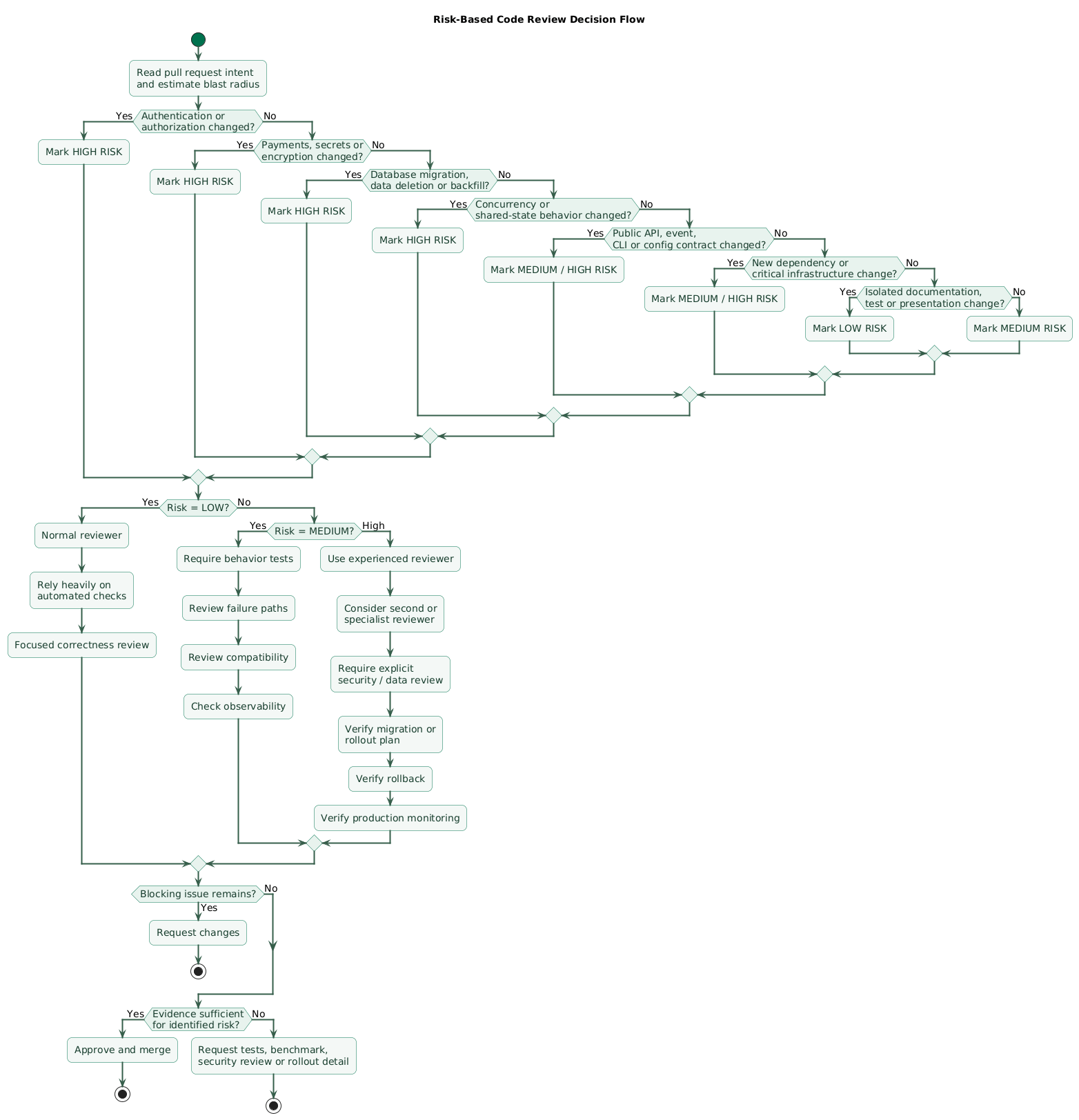
Risk-based code review decision flow (diagram)
Low-risk example
documentation typo

copy change

isolated test cleanup
Normal review may be enough.
Medium-risk example
new endpoint

new business validation

moderate refactor

background job change
Require:
behavior tests

failure review

compatibility review
High-risk example
authentication

authorization

payments

schema migration

data deletion

concurrency

encryption

secret handling

new infrastructure dependency
Consider:
specialist review

security review

migration plan

staged rollout

rollback verification

production monitoring
Risk depends on blast radius
A five-line change to:
global authorization middlewaremay deserve more review than:
500-line internal admin reportAsk what happens if the reviewer is wrong
minor visual bug?

failed request?

security exposure?

money loss?

data corruption?
That answer should influence review depth.
15. Copy/paste code review checklist
Small-team code review checklist

Pull request intent
- Is the problem clearly described?
- Is expected behavior clear?
- Is non-goal behavior clear?
- Is the change actually necessary?
- Does implementation match the stated goal?
- Are important product assumptions documented?

Scope
- Is the pull request focused?
- Are unrelated changes included?
- Could risky independent parts be separated?
- Are formatting-only changes mixed with behavior changes?
- Are generated files separated conceptually from source changes?
- Is the diff small enough to understand?

Risk classification
- Is this authentication-related?
- Is this authorization-related?
- Does it handle money?
- Does it delete data?
- Does it modify database schema?
- Does it change public API?
- Does it change event schema?
- Does it affect concurrency?
- Does it add a dependency?
- Does it modify secret handling?
- Does it affect critical infrastructure?

Correctness
- Does happy path work?
- Are boundary cases correct?
- Are missing values handled?
- Are empty values handled?
- Are duplicates handled?
- Are invalid states rejected?
- Are defaults correct?
- Are units correct?
- Are timezones correct?
- Is ordering correct?

Conditions
- Are boolean expressions correct?
- Are operator precedence assumptions obvious?
- Are off-by-one errors possible?
- Are inclusive / exclusive boundaries correct?
- Are null checks correct?
- Are early returns safe?
- Are all branches reachable as intended?

State transitions
- Is current state validated?
- Is requested transition allowed?
- Can terminal state transition incorrectly?
- Can repeated request change result?
- Is idempotency needed?
- Is transition atomic where required?

Errors
- Are expected failures represented correctly?
- Are unexpected failures visible?
- Is original cause preserved?
- Are errors swallowed?
- Are stack traces exposed to users?
- Are safe messages returned?
- Is cleanup executed?
- Does failure leave partial state?

Tests
- Does new behavior have tests?
- Would tests fail before implementation?
- Are happy-path tests present?
- Are negative tests present?
- Are edge cases present?
- Are boundary values tested?
- Are regression tests included for bug fixes?
- Are failure paths tested?
- Are side effects tested?
- Are tests deterministic?

Test quality
- Are tests asserting behavior rather than implementation?
- Are mocks necessary?
- Are mocks too tightly coupled?
- Are fixtures readable?
- Are test names descriptive?
- Are tests independent?
- Are time and randomness controlled?
- Are flaky assumptions introduced?

Coverage
- Do not review coverage percentage alone.
- Check risky branches.
- Check critical contracts.
- Check authorization failures.
- Check transaction failures.
- Check migration behavior.
- Check bugs permanently.

Authentication
- Is identity established from trusted source?
- Are unauthenticated requests rejected?
- Are authentication errors safe?
- Is session / token verification correct?
- Are expiration rules correct?
- Are revocation rules considered?

Authorization
- Is action authorized?
- Is resource ownership checked?
- Is tenant boundary enforced?
- Is role check sufficient?
- Is authorization performed server-side?
- Can client-controlled fields grant privilege?
- Are admin paths protected separately?
- Is default-deny behavior preserved where appropriate?

Input validation
- Are external inputs validated?
- Are types validated?
- Are sizes bounded?
- Are enum values checked?
- Are IDs validated?
- Are nested structures validated?
- Are unexpected fields handled intentionally?
- Are file uploads constrained?
- Are URLs constrained where necessary?

Injection
- Is SQL parameterized?
- Is shell execution safe?
- Is HTML output encoded?
- Is template input safe?
- Are paths constructed safely?
- Are LDAP / query expressions parameterized where supported?
- Is user input used inside regex safely?
- Is eval avoided?

SQL
- Avoid string concatenation with user input.
- Use prepared statements.
- Check query scope.
- Check tenant filter.
- Check authorization filter.
- Check transaction boundaries.
- Check lock behavior.
- Check N+1 queries.

Shell commands
- Prefer direct process APIs.
- Keep executable and arguments separate.
- Avoid shell interpolation.
- Validate file paths.
- Avoid untrusted command fragments.
- Handle exit status.
- Handle timeout.
- Handle cancellation.

Files
- Validate paths.
- Prevent path traversal where relevant.
- Use safe temporary files.
- Check permissions.
- Avoid unsafe overwrite.
- Clean temporary files.
- Handle symbolic links according to threat model.
- Avoid leaking sensitive paths.

Secrets
- No hard-coded credentials.
- No production tokens.
- No private keys.
- No secret values in tests committed publicly.
- Do not log secrets.
- Do not return secrets in errors.
- Redact diagnostic output.
- Use approved secret source.

Sensitive data
- Minimize collection.
- Minimize logging.
- Validate access control.
- Check retention.
- Check encryption requirements.
- Avoid exposing data in URLs where inappropriate.
- Avoid accidental analytics collection.

Dependencies
- Is new dependency necessary?
- Is library maintained?
- Is version pinned appropriately?
- Are transitive dependencies understood?
- Does lock file change as expected?
- Does dependency execute install scripts?
- Does it add network behavior?
- Does it introduce licensing concerns?
- Is standard library sufficient?

Serialization
- Is untrusted deserialization safe?
- Are allowed types constrained?
- Are unknown fields handled?
- Are numeric assumptions safe?
- Are schema versions compatible?
- Are secrets excluded?
- Are defaults intentional?

Database schema
- Is migration backward compatible?
- Can old and new app versions coexist?
- Does migration lock large tables?
- Does migration rewrite all rows?
- Is new column nullable when required for rollout?
- Is constraint added safely?
- Is index creation operationally safe?
- Can migration retry?

Backfills
- Is job idempotent?
- Is progress tracked?
- Is work batched?
- Is load bounded?
- Can it restart?
- Can partial completion be detected?
- Are bad rows handled?
- Is rollback or repair possible?

Data integrity
- Are database constraints present where needed?
- Are uniqueness assumptions enforced?
- Are foreign keys appropriate?
- Are transactions correct?
- Can partial write occur?
- Can concurrent requests violate invariant?
- Are deletes cascading safely?

Transactions
- Is transaction scope correct?
- Are external network calls inside transaction unnecessarily?
- Is rollback tested?
- Is commit ordering correct?
- Is transaction too large?
- Are locks held longer than necessary?
- Can retry duplicate side effects?

Concurrency
- Are shared values synchronized?
- Is read-modify-write atomic?
- Is optimistic locking needed?
- Is pessimistic locking needed?
- Is distributed coordination required?
- Is ordering guaranteed where assumed?
- Are races covered by constraints?
- Can duplicate work occur?

Async
- Are tasks awaited?
- Are detached tasks owned?
- Are failures observed?
- Is cancellation propagated?
- Are resources cleaned?
- Is concurrency bounded?
- Can one request create unbounded tasks?

Retries
- Are only transient failures retried?
- Are attempts bounded?
- Is backoff present?
- Is jitter useful?
- Is operation idempotent?
- Can retry duplicate payment or write?
- Is deadline respected?
- Is cancellation respected?

Timeouts
- Do external calls have timeouts?
- Are database waits bounded where needed?
- Is timeout value reasonable?
- Is timeout distinguishable from underlying failure?
- Is deadline propagated?

Maintainability
- Are names clear?
- Are functions cohesive?
- Are side effects obvious?
- Is coupling reasonable?
- Is code understandable without hidden context?
- Are abstractions justified?
- Is unnecessary complexity introduced?
- Is domain language consistent?

Naming
- Do names describe intent?
- Do boolean names read clearly?
- Do units appear where needed?
- Is ownership clear?
- Are side-effecting methods named clearly?
- Avoid vague names such as data, process, handle when domain term exists.

Functions
- Is function doing one cohesive job?
- Are parameters reasonable?
- Are hidden dependencies avoided?
- Are return values clear?
- Are errors clear?
- Are side effects mixed with calculations unnecessarily?

Classes / modules
- Is responsibility cohesive?
- Are unrelated concerns mixed?
- Is dependency direction sensible?
- Is public surface small?
- Is shared mutable state minimized?
- Is lifecycle clear?

Abstractions
- Does abstraction remove real duplication or isolate real variation?
- Is abstraction premature?
- Are interfaces meaningful?
- Is generic framework needed?
- Does indirection make debugging harder?
- Could simpler code work?

Duplication
- Is duplicated logic genuinely same behavior?
- Would copies change together?
- Is extraction clearer?
- Avoid deduplication that combines unrelated policies.
- Avoid copy-paste bugs.

Comments
- Do comments explain why?
- Are comments still accurate?
- Is commented-out code removed?
- Is surprising business rule documented?
- Could important rule be represented by test?

Performance
- Does change affect hot path?
- Is input size known?
- Are repeated scans introduced?
- Are nested loops acceptable?
- Are allocations excessive?
- Is caching justified?
- Is serialization cost relevant?
- Is algorithmic complexity reasonable?

Database performance
- Is N+1 introduced?
- Are indexes available?
- Are queries selective?
- Is query plan likely to change?
- Is large table scanned?
- Is pagination required?
- Are large results materialized unnecessarily?

Network performance
- Is fan-out bounded?
- Are calls parallelized safely where useful?
- Is batching possible?
- Are payloads bounded?
- Is compression appropriate?
- Are retries amplifying traffic?
- Are timeouts configured?

Memory
- Are large objects retained?
- Are collections bounded?
- Are streams preferable?
- Are caches bounded?
- Are temporary buffers excessive?
- Can request trigger memory spike?

API compatibility
- Are fields removed?
- Are field types changed?
- Are required fields added?
- Are enum values narrowed?
- Is default behavior changed?
- Are error codes changed?
- Are status codes changed?
- Are units changed?

Event compatibility
- Are old consumers supported?
- Are new fields optional?
- Are field meanings stable?
- Is schema versioning needed?
- Can historical events still replay?
- Are ordering assumptions preserved?

CLI compatibility
- Are options renamed?
- Are exit codes changed?
- Is machine output changed?
- Is stderr / stdout behavior changed?
- Are defaults changed?
- Are scripts likely to depend on behavior?

Configuration
- Are names stable?
- Are defaults safe?
- Are old keys supported if required?
- Are secrets handled safely?
- Is precedence unchanged?
- Are invalid values rejected?

Observability
- Will failure be visible?
- Are useful logs present?
- Are logs structured where appropriate?
- Are request / correlation IDs preserved?
- Are new critical operations measured?
- Are sensitive values excluded?
- Is important failure counted?

Logging
- Avoid duplicate log-and-rethrow.
- Avoid secrets.
- Avoid personal data where unnecessary.
- Include safe context.
- Use appropriate severity.
- Avoid noisy logs in hot loops.
- Avoid logging successful high-volume operations excessively.

Metrics
- Is success rate measurable?
- Is failure rate measurable?
- Is latency measurable?
- Is retry count measurable?
- Is queue depth measurable?
- Is saturation measurable?
- Is metric cardinality bounded?

Alerts
- Does new critical dependency need detection?
- Is alert actionable?
- Is threshold meaningful?
- Is owner clear?
- Avoid alerting on every recoverable error.

Deployment
- Can old and new versions coexist?
- Is feature flag needed?
- Is staged rollout useful?
- Is migration order correct?
- Are services deployed in compatible order?
- Is cache format compatible?
- Is rollback possible?

Feature flags
- Is default safe?
- Is both behavior tested?
- Is flag scoped?
- Is owner defined?
- Is removal planned?
- Can flag disable broken feature quickly?
- Avoid permanent forgotten flags.

Rollback
- Can previous application version run?
- Is schema backward compatible?
- Has irreversible data already changed?
- Can feature be disabled?
- Are external side effects reversible?
- Is emergency procedure known?

Operations
- Does support team need documentation?
- Does runbook change?
- Does monitoring dashboard need update?
- Are manual recovery steps required?
- Are failure modes understood?

Review comments
- State problem clearly.
- Explain why it matters.
- Suggest direction where useful.
- Distinguish blocker from suggestion.
- Ask questions when context is missing.
- Avoid personal language.
- Avoid vague criticism.
- Prefer actionable comments.

Blocking comments
- Correctness defect.
- Security issue.
- Data-loss risk.
- Broken public contract.
- Missing critical test.
- Unsafe migration.
- Unhandled high-impact failure.
- Serious performance regression.

Suggestions
- Naming improvement.
- Small readability improvement.
- Alternative abstraction.
- Optional cleanup.
- Future refactor.
- Nonessential style preference.

Automated checks
- Formatting automated.
- Lint automated.
- Type checking automated.
- Unit tests automated.
- Integration tests automated where practical.
- Static security checks automated.
- Dependency scanning automated.
- Build verification automated.

Review process
- Author self-reviews diff.
- CI passes before human review where practical.
- Reviewer understands intent.
- Reviewer classifies risk.
- Reviewer checks highest-risk areas first.
- Author resolves blockers.
- New changes are re-reviewed where necessary.
- Approval means risk is acceptable.

High-risk changes
- Authentication.
- Authorization.
- Payments.
- Encryption.
- Secrets.
- Data deletion.
- Database migration.
- Concurrency.
- Public API.
- Infrastructure dependency.
- Security-sensitive parser.
- File permissions.
- Privileged operations.

High-risk review
- Require experienced reviewer.
- Consider second reviewer.
- Consider security specialist.
- Require explicit tests.
- Require failure-path tests.
- Review rollback.
- Review observability.
- Consider staged rollout.
- Monitor after deployment.

Low-risk review
- Keep process lightweight.
- Do not require security ceremony for typo-only documentation.
- Rely on automation for mechanical checks.
- Preserve fast feedback.

Author self-review
- Read complete diff before requesting review.
- Remove debug code.
- Remove unrelated changes.
- Check test names.
- Check comments.
- Check TODOs.
- Check secrets.
- Check generated files.
- Explain risky areas in description.

Before approval
- Intent understood.
- Correctness checked.
- Tests meaningful.
- Security reviewed at appropriate depth.
- Data impact understood.
- Compatibility understood.
- Maintainability acceptable.
- Performance risk acceptable.
- Deployment safe.
- Rollback understood.

Final review
- Does this change solve the stated problem?
- Is the diff focused?
- Is important behavior correct?
- Are edge cases covered?
- Are failure paths safe?
- Are tests meaningful?
- Is authorization correct?
- Is input validated?
- Are secrets protected?
- Are injection risks controlled?
- Are migrations safe?
- Is data integrity preserved?
- Is concurrency safe?
- Are public contracts compatible?
- Is code maintainable?
- Is performance reasonable for expected scale?
- Will production failures be visible?
- Are timeouts and retries sensible?
- Can the change be rolled back?
- Is review depth appropriate to blast radius?
- Would another developer understand why this code is safe to merge?
16. FAQ
What should a reviewer check first in a pull request?
Start with intent. Understand what problem is being solved, what behavior should change, and what should remain unchanged. Then verify that the diff actually implements that behavior.
Should every code review use the entire checklist?
No. The checklist is a menu of risk areas. A documentation change does not need the same depth as an authorization, payment, database migration, or concurrency change. Apply deeper review where blast radius is larger.
What security issues are most important during code review?
Pay particular attention to authorization, authentication boundaries, input validation, injection, secrets, sensitive logging, file and command execution, unsafe deserialization, dependencies, and access to sensitive data.
Should reviewers request refactors unrelated to the change?
Usually not as blockers unless existing structure makes the current change unsafe. Unrelated improvements can be documented as suggestions or follow-up work rather than expanding the pull request indefinitely.
How many reviewers should a small team require?
There is no universal number. One knowledgeable reviewer may be adequate for ordinary changes, while authentication, payments, migrations, cryptography, infrastructure, or other high-impact changes may justify a second reviewer or specialist.
Should code review comments include suggested code?
They can when a concrete example makes the concern clearer, but the most important part is explaining the risk or maintainability issue. A reviewer does not need to rewrite the complete solution for every comment.
What does approval mean?
Approval means the reviewer believes the remaining risk is acceptable and the change meets the team's quality bar. It does not mean the reviewer would personally implement every detail in exactly the same way.
Key terms (quick glossary)
- Code review
- The process of evaluating a proposed code change for correctness, security, maintainability, operational safety, and alignment with the intended behavior.
- Pull request
- A proposed set of source-control changes submitted for discussion, automated checks, review, and eventual merge.
- Blast radius
- The amount of the system, user population, data, or infrastructure that could be affected if a change fails.
- Blocking comment
- A review finding that should be resolved before merge because it affects correctness, security, data safety, compatibility, or another required quality property.
- Suggestion
- A non-blocking review recommendation that may improve clarity, maintainability, or design without being necessary for safe merge.
- Regression test
- A test that protects behavior associated with a previously discovered defect so the same defect does not return unnoticed.
- Backward compatibility
- The ability of newer software or schemas to continue working with existing consumers, data, or older deployed components.
- N+1 query
- A database access pattern where one initial query is followed by an additional query for each returned item, often causing excessive database traffic.
- Idempotency
- The property that repeating an operation does not create unintended additional effects beyond the intended result.
- Feature flag
- A runtime control used to enable or disable behavior independently from deploying the underlying code.
- Static analysis
- Automated examination of source or compiled code without executing the full application, commonly used to identify bugs, style problems, and some security weaknesses.
- Authorization
- The decision about whether an authenticated identity may perform a specific action on a particular resource.
- Data migration
- A controlled change to stored data or database structure required when application data models evolve.
- Rollback
- Returning a system to a previous known-good software or configuration state after a problematic deployment.
- Observability
- The ability to understand a running system through signals such as logs, metrics, traces, and externally visible behavior.
- Risk-based review
- A review strategy that applies more scrutiny to changes with greater probability or impact of failure.
Worth reading
Recommended guides from the category.