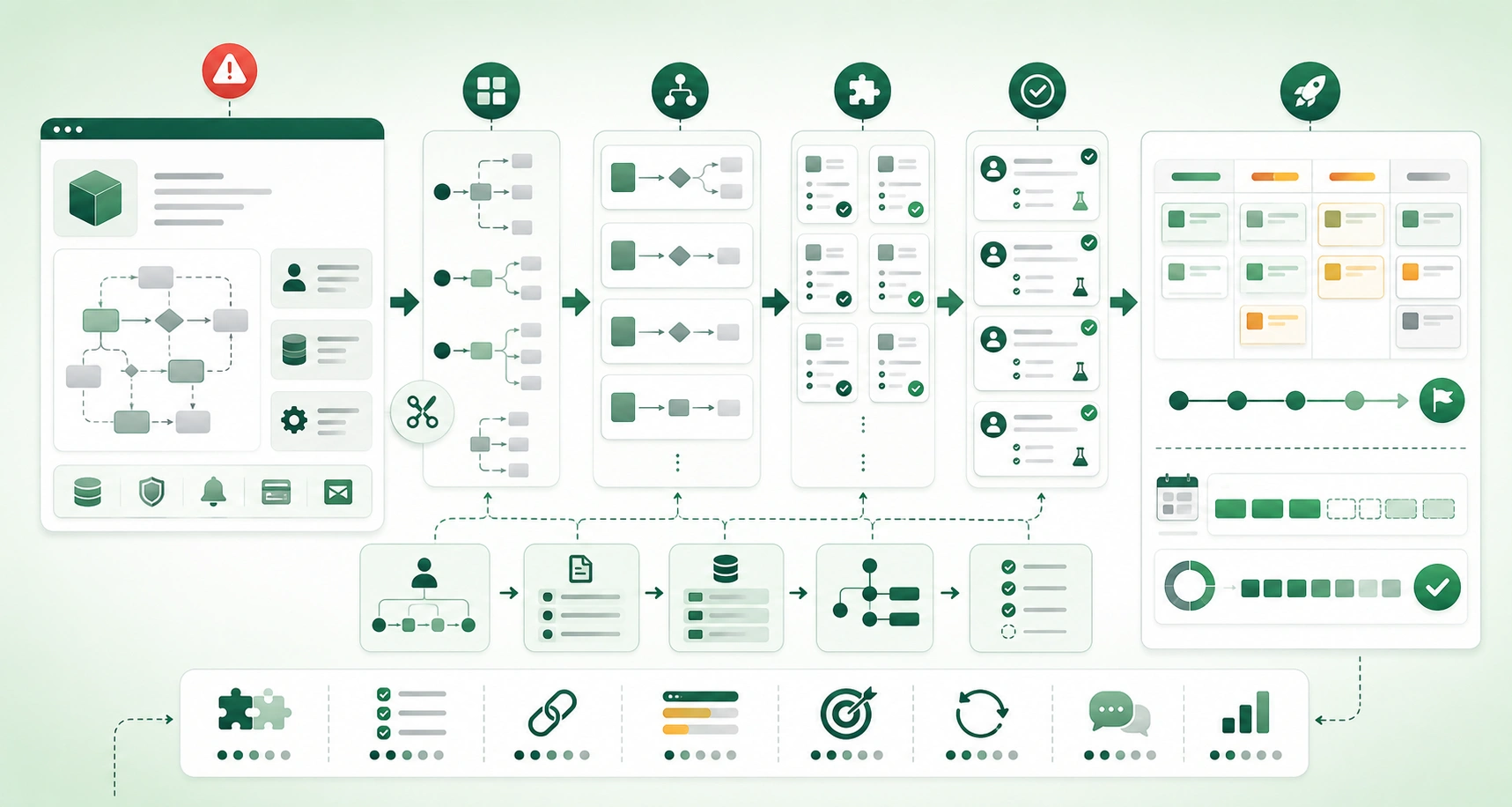
A large feature often enters a backlog as something like:
Build team invitations.That sentence may hide:
invitation creation
email delivery
acceptance
expiry
permissions
duplicate handling
cancellation
resending
audit logging
error recovery
Turning that feature into useful stories is not a matter of creating one ticket for each technical component.
The objective is to create:
small
valuable
testable
understandable
incrementally deliverable
slices of behavior.
Split by value before splitting by architecture
A database ticket, API ticket, and frontend ticket may divide the engineering work, but none necessarily delivers usable behavior. Whenever possible, create a thin end-to-end slice that lets a user or stakeholder observe something working.
1. Start with the outcome, not the ticket list
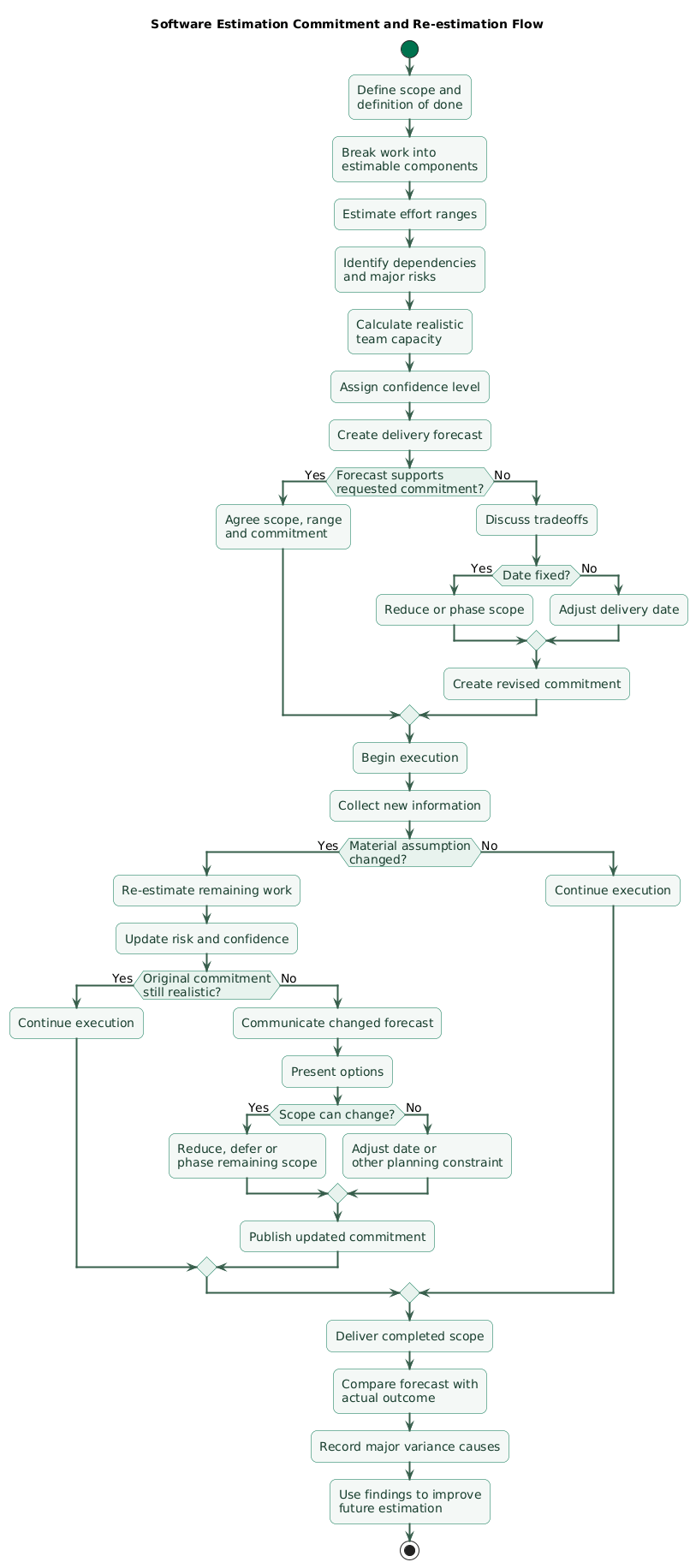
Feature-to-user-story breakdown flow (diagram)
Begin with:
What outcome should become possible?Not:
Which classes do we need?Weak feature definition
Build notifications.Stronger outcome
Users should be notified
when an assigned task
changes status.
This immediately clarifies:
who
what event
what value
Write the business objective
Reduce missed task updates
for collaborators.
Define success
A user assigned to a task
can receive a notification
after another user changes
the task status.
Separate goals from implementation
Avoid defining the feature as:
Add NotificationService,
Kafka topic, database table,
and React modal.
Those may become implementation decisions later.
2. Identify users, actors, and permissions
A feature may look simple until different actors are considered.
Example: team invitations
Workspace owner

Workspace admin

Invited user

Existing member

Expired invite recipient
Ask what each actor wants to accomplish
Admin:
invite a person

Invitee:
accept invitation

Admin:
cancel invitation

Invitee:
know why an expired
invitation no longer works
Permissions can create natural story boundaries
For example:
Story 1:
Workspace owner can invite members.

Story 2:
Workspace admin can invite members.

Story 3:
Ordinary members cannot invite members.
Whether these should be separate stories depends on complexity and value, but identifying the role differences early exposes the rules.
Do not create a separate persona without behavioral difference
If:
owner
and
admin
follow exactly the same workflow and permissions, splitting purely by label may create unnecessary tickets.
3. Map the user workflow before splitting
Write the sequence the user experiences.
Example invitation workflow
Admin opens members page
        ↓
enters email
        ↓
sends invitation
        ↓
invitee receives link
        ↓
invitee opens link
        ↓
accepts
        ↓
membership created
        ↓
admin sees new member
Workflow steps reveal candidate stories
Create invitation

Deliver invitation

Accept invitation

Show membership

Cancel invitation

Resend invitation
Start with the backbone
A story map can begin with major activities:
Invite
Accept
Manage
Recover
Then add details under each activity.
Do not start by listing every exception
First understand:
normal user journeybefore expanding into:
expired
duplicate
revoked
invalid
unauthorized
variants.
4. Slice vertically instead of by technical layer
Horizontal slicing
Story 1:
Create database tables.

Story 2:
Build API endpoints.

Story 3:
Build frontend.

Story 4:
Connect everything.
The main problem:
usable value appears
only after Story 4
Vertical slicing
Story 1:
Admin can invite one user
by email.

Includes:
minimal UI
minimal API
minimal persistence
This may be technically less complete but produces an end-to-end capability.
Why vertical slices help
earlier feedback

earlier integration testing

less unfinished inventory

lower merge risk

better prioritization
Thin does not mean fake
A thin slice should still be:
real
testable
production-compatible
even when it handles only a narrow scenario.
5. Build the thinnest happy-path story first
For team invitations, the first slice might be:
As a workspace owner,
I can invite a new user
using a valid email address
so that they can join
my workspace.
Limit the first slice deliberately
One role:
owner

One channel:
email

One invite at a time

No resend yet

No custom message yet
Keep essential safety
Thin does not justify skipping:
authorization
basic validation
security checks
core tests
Then expand incrementally
Story 2:
Invitee accepts valid invitation.

Story 3:
Expired invitation is rejected.

Story 4:
Admin can resend invitation.

Story 5:
Admin can cancel invitation.
Use early slices to validate architecture
A minimal end-to-end workflow can reveal:
authentication problem

email-provider issue

routing problem

schema mismatch

unexpected permission rule
before the full feature is built.
6. Use repeatable story-splitting strategies
User story slicing strategies (diagram)
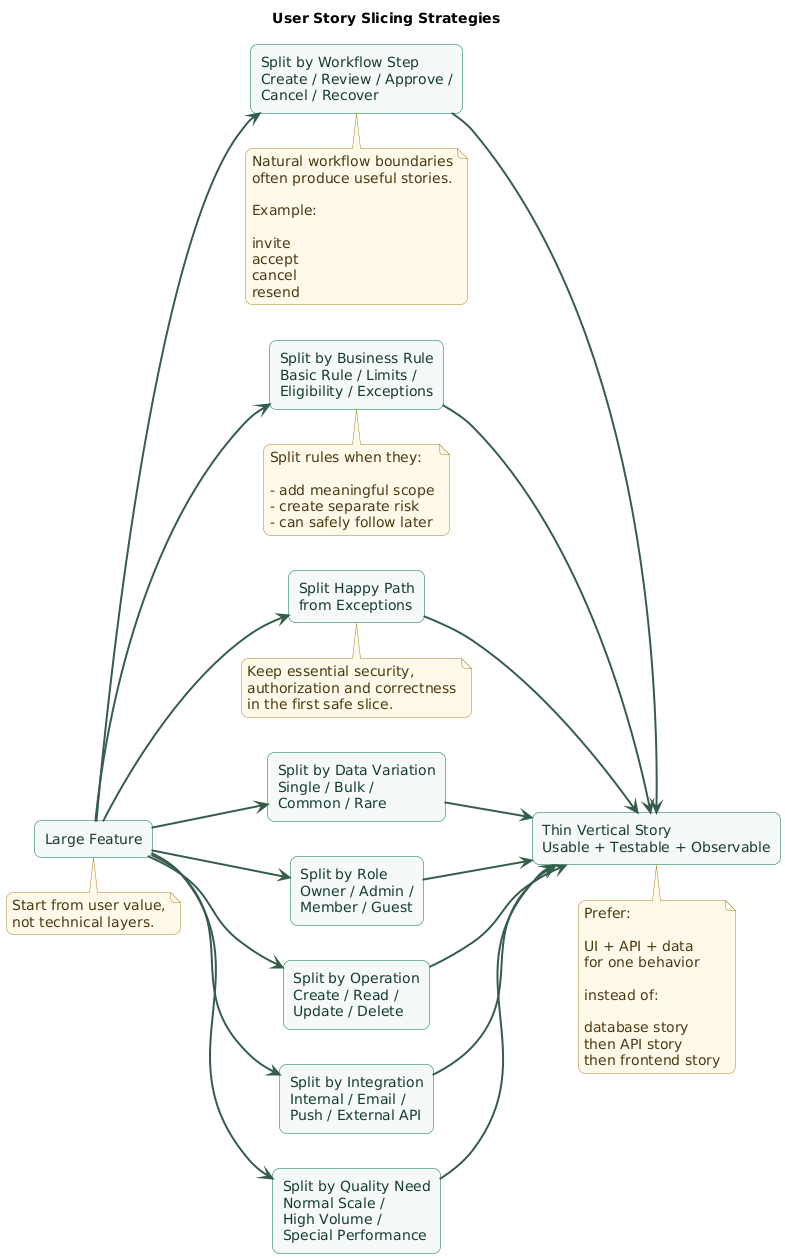
Split by workflow step
Create invite

Accept invite

Cancel invite

Resend invite
Split by business rule
Basic invite

Prevent duplicate active invite

Reject banned domain

Limit invitations per day
Split by data variation
Single file upload

Multiple files

Large files

Image-specific metadata
Split by role
Owner can approve.

Manager can approve.

Member can view only.
Split by operation
CRUD can sometimes provide useful boundaries:
Create
Read
Update
Delete
but only when each operation produces useful behavior independently.
Split by exception
Valid payment succeeds.

Declined payment is shown clearly.

Duplicate submission is prevented.
Split by integration
Store notification internally.

Send email notification.

Send push notification.
Split by quality level when safe
Support normal expected load.

Then optimize for
high-volume bulk operation.
Do not defer security or correctness that is necessary for safe operation.
7. Split complex business rules deliberately
A story can appear small while hiding many rules.
Example
As a customer,
I can apply a discount code.
Hidden rules:
minimum order value

expiry date

customer eligibility

product exclusions

usage limit

currency restrictions

stacking rules
Start with the simplest valid rule set
Story 1:
Valid active discount applies
to an eligible order.
Then add rules
Story 2:
Expired discount is rejected.

Story 3:
Minimum order value enforced.

Story 4:
Usage limit enforced.

Story 5:
Excluded products ignored.
Do not split every if statement
Several closely related rules may be easier to understand and test together.
Split when:
rule has independent value

rule creates meaningful risk

rule can be delivered later

rule materially enlarges testing
8. Add edge cases without creating one giant story
Common edge cases include:
empty input

duplicate request

expired state

concurrent action

missing resource

invalid permission

network failure
Some edge cases belong in the base story
Basic validation such as:
invalid email rejectedmay be essential to the first invitation story.
Some can become later stories
Resend an expired invitation.

Recover after email provider failure.

Bulk invite from CSV.
Use risk to decide
Ask:
Would shipping without this case
be unsafe, incorrect, or unusable?
If yes, keep it in the initial story or release slice.
Do not call correctness optional
These are not harmless follow-ups:
prevent unauthorized access later

validate payment amount later

protect duplicate charge later
9. Write acceptance criteria around observable behavior
Weak criteria
Create InvitationService.

Add invitations table.

Add POST endpoint.
Those are implementation tasks.
Behavior-oriented criteria
Given a workspace owner

and an email that is not
already a member

when the owner sends an invitation

then an active invitation is created

and the recipient receives
an invitation email.
Include important boundaries
Given an ordinary member

when they attempt to invite a user

then the request is rejected

and no invitation is created.
Keep criteria testable
Weak:
The invitation should work well.Better:
Invitation link remains valid
for seven days.
Avoid implementation prescription unless necessary
Prefer:
The duplicate invitation
is rejected.
over:
Use Redis SETNX
to prevent duplicates.
unless the implementation choice itself is an architectural requirement.
10. Keep technical enablers and spikes explicit
Not every backlog item has direct user value.
Technical enabler
Add backward-compatible
invitation token column.
Migration work
Backfill workspace ownership
before enabling new permissions.
Infrastructure
Provision email-delivery
credentials for production.
Spike
Determine whether identity provider
supports invitation acceptance
without an existing account.
Do not invent fake users
Weak:
As a database,
I want a new index.
Better:
Technical task:
Add index required for
invitation lookup latency.
Link enablers to the value they support
Enabler:
Create invitation schema

Supports:
Owner can invite user
This keeps technical work connected to product intent.
11. Reduce dependencies between stories
A backlog such as:
database story
     ↓
backend story
     ↓
frontend story
     ↓
integration story
creates a long dependency chain.
Prefer independently testable slices
Story A:
Owner sends one invitation.

Story B:
Invitee accepts invitation.
Use backward-compatible groundwork
If schema support is required:
add nullable field
     ↓
deploy
     ↓
use field in new story
can reduce coordination risk.
Use feature flags where appropriate
deploy incomplete supporting code

keep feature disabled

enable when end-to-end slice ready
Define interfaces early when parallel work is necessary
request schema

response schema

error behavior

mock / fixture
can allow frontend and backend work to proceed with less ambiguity.
But avoid excessive parallelism
Too many partially completed stories increase:
context switching

integration risk

unfinished work
12. Sequence stories for early learning and value
Start with high-learning slices
If the riskiest part is:
external identity providerdo not leave that integration until the final story.
Walking skeleton
A walking skeleton is a minimal end-to-end implementation that crosses the architecture.
UI action
   ↓
API
   ↓
database
   ↓
external service
   ↓
visible result
It may have very limited functionality but proves that the main system path works.
Sequence by value
1. Owner can invite one user.

2. Invitee can accept.

3. Owner can see pending invites.

4. Owner can resend.

5. Owner can cancel.
Sequence by risk when appropriate
1. Prove email provider integration.

2. Prove secure invitation token.

3. Build normal workflow.
Delay optional complexity
bulk invite

custom invitation message

CSV import

advanced reporting
can follow after the core behavior has demonstrated value.
13. Check whether a story is actually ready
User story readiness and delivery loop (diagram)
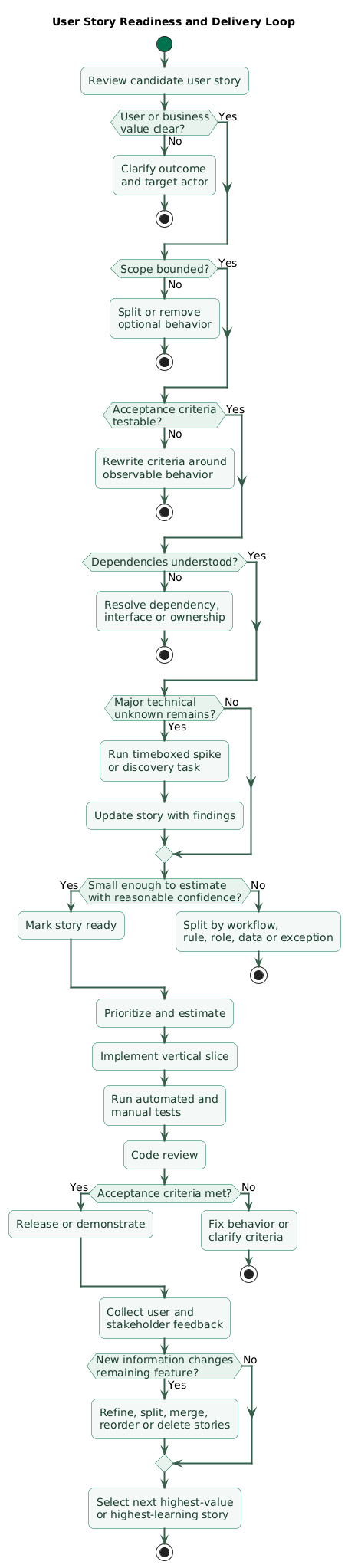
Value is clear
Who benefits?

What becomes possible?
Scope is bounded
The team knows what is:
included
excluded
Acceptance criteria are testable
Another person can determine:
done
or
not done
Dependencies are understood
API available?

design ready?

environment ready?

migration ready?
Unknowns are manageable
If the team still says:
We have no idea whether
the provider supports this.
a spike may be needed before delivery estimation.
The story is small enough to discuss
If refinement requires:
45 minutes
and
20 acceptance criteria
the story may contain several independently useful behaviors.
Use INVEST as a prompt, not a law
Independent

Negotiable

Valuable

Estimable

Small

Testable
Real systems sometimes require dependencies, but the model is useful for identifying problematic stories.
14. Refine stories as evidence changes
Story decomposition is not a one-time planning ceremony.
Before implementation
clarify
split
remove
reorder
During implementation
The team may discover:
new business rule

unexpected integration behavior

simpler implementation

unnecessary requirement
Split newly discovered work explicitly
Suppose the team discovers:
invitation email must support
three branding variants
Rather than silently expanding the current story:
finish default branding

create follow-up story
for custom branding
if the default behavior remains useful and safe.
Merge stories when decomposition adds no value
If two stories:
cannot be tested independently

cannot be delivered independently

always change together
they may have been split too aggressively.
Delete stories that no longer matter
A backlog is not a historical archive.
Remove:
obsolete assumptions

superseded implementation work

features no longer valuable
15. Copy/paste feature breakdown checklist
Feature-to-user-story checklist

Feature goal
- What problem is being solved?
- Who experiences the problem?
- What outcome should become possible?
- What business result matters?
- How will success be recognized?
- Is the feature goal written without implementation detail?

Actors
- Primary user identified.
- Secondary users identified.
- Admin role identified where relevant.
- External systems identified.
- Automated actors identified.
- Permission differences understood.
- Do different roles actually need different behavior?

Workflow
- Starting state identified.
- User trigger identified.
- Main workflow mapped.
- End state identified.
- Important intermediate states identified.
- External interactions identified.
- User-visible outcomes identified.

Story map
- Major activities identified.
- Workflow steps arranged in order.
- Essential release slice identified.
- Optional later slices identified.
- Risks visible.
- Dependencies visible.
- Gaps visible.

Vertical slicing
- Avoid database-only story where possible.
- Avoid backend-only story where possible.
- Avoid frontend-only story where possible.
- Prefer end-to-end user behavior.
- Include only technical layers needed for the slice.
- Make result demonstrable.
- Make result testable.

First slice
- Choose simplest valuable happy path.
- Limit roles.
- Limit data variations.
- Limit optional configuration.
- Keep core validation.
- Keep authorization.
- Keep essential security.
- Keep required correctness.
- Deliver something real.

Workflow splitting
- Create.
- Review.
- Approve.
- Reject.
- Cancel.
- Resend.
- Search.
- Export.
- Recover.
- Notify.
- Use workflow boundaries where they create value.

Business-rule splitting
- Basic rule first.
- Additional eligibility rule later.
- Limits later where safe.
- Exceptions later where safe.
- Complex calculations isolated.
- Regulatory rules kept mandatory where required.
- Do not defer critical correctness.

Data variation splitting
- Single item before bulk.
- Standard format before alternative formats.
- Small input before specialized large-input workflow.
- Common data before rare variants.
- One integration source before several sources.

Role splitting
- Split when behavior differs materially.
- Split when permission logic is substantial.
- Avoid duplicate stories when roles behave identically.
- Include unauthorized behavior in acceptance criteria where necessary.

CRUD splitting
- Create independently useful?
- Read independently useful?
- Update independently useful?
- Delete independently useful?
- Do not use CRUD mechanically.
- Prefer workflow value over operation names.

Happy path
- Main valid input.
- Main authorized user.
- Main successful dependency.
- Main successful output.
- Essential persistence.
- Essential verification.

Edge cases
- Empty input.
- Missing input.
- Invalid input.
- Duplicate input.
- Expired state.
- Already completed state.
- Missing resource.
- Unauthorized user.
- Dependency unavailable.
- Retry.
- Concurrent request.
- Partial failure.

Edge-case decision
- Is it required for safety?
- Is it required for correctness?
- Is it required for basic usability?
- Can it safely follow later?
- Does it create meaningful independent value?
- Does it materially increase testing?

Security
- Authentication required?
- Authorization required?
- Ownership check?
- Tenant boundary?
- Input validation?
- Sensitive data?
- Secret handling?
- Injection risk?
- File upload risk?
- Abuse limits?
- Critical security is not a future enhancement.

Acceptance criteria
- Observable behavior.
- Clear starting condition.
- Clear action.
- Clear expected result.
- Important negative behavior.
- Important permission behavior.
- Important boundary values.
- Avoid unnecessary implementation detail.
- Testable by another person.

Given / when / then
- Given relevant state.
- When meaningful action occurs.
- Then observable result follows.
- Avoid giant scenario with many unrelated outcomes.
- Use several scenarios when boundaries matter.

Definition of done
- Code implemented.
- Tests implemented.
- Review completed.
- Documentation updated where needed.
- Migration included where needed.
- Monitoring included where needed.
- Feature flag included where needed.
- Deployment path understood.

Technical tasks
- Do not invent fake user personas.
- Label technical enabler clearly.
- Link it to supported user value.
- Keep scope bounded.
- Make completion criteria explicit.
- Sequence before dependent story only when required.

Spikes
- Use for uncertainty.
- Define question.
- Timebox investigation.
- Define expected output.
- Record findings.
- Avoid using spike as open-ended implementation.
- Re-estimate after spike.

Dependencies
- Another story?
- Another team?
- Vendor?
- API?
- Design?
- Environment?
- Migration?
- Security approval?
- Test data?
- Dependency owner identified.
- Readiness understood.

Dependency reduction
- Use backward-compatible changes.
- Use interfaces.
- Use mocks or fixtures.
- Use feature flags.
- Use adapters.
- Use thin vertical slices.
- Avoid long horizontal chains.
- Avoid unnecessary synchronization.

Sequencing
- Value first.
- Risk early.
- Learning early.
- Dependencies early when necessary.
- Optional polish later.
- Bulk behavior later.
- Rare variants later.
- Keep release path visible.

Walking skeleton
- One end-to-end path.
- Real architecture.
- Minimal behavior.
- Real integration.
- Real persistence where required.
- Visible result.
- Useful for proving system path.

Release slicing
- What is the smallest usable release?
- Which stories are mandatory?
- Which stories are optional?
- Which can ship behind flags?
- Which reduce risk?
- Which generate feedback?
- Which can wait?

Story size
- One primary user goal.
- Bounded rules.
- Bounded workflow.
- Manageable test cases.
- Understandable dependencies.
- Reasonable estimation confidence.
- Avoid arbitrary line or hour limits.

Large-story warning signs
- Several user goals.
- Several unrelated roles.
- Many workflow steps.
- Many business rules.
- Many integrations.
- Many unknowns.
- Long acceptance criteria.
- Hard to estimate.
- Cannot explain in a few sentences.
- Cannot demonstrate one outcome.

Over-splitting warning signs
- Stories have no independent behavior.
- Stories cannot be tested independently.
- Stories only represent individual classes.
- Every story must merge together before anything works.
- Ticket administration exceeds value.
- Artificial persona language.
- Excessive microtasks.

INVEST review
- Independent enough.
- Negotiable.
- Valuable.
- Estimable.
- Small enough.
- Testable.
- Treat as guidance, not dogma.

Estimation
- Story scope understood.
- Unknowns manageable.
- Dependencies identified.
- Acceptance criteria available.
- Compare with reference stories.
- Split before estimating if range is too wide.
- Use spike for major unknowns.

Refinement
- Product context available.
- Developer context available.
- Design context available where needed.
- Test perspective included.
- Security perspective included for risky work.
- Split oversized stories.
- Remove obsolete stories.
- Reorder based on learning.

Implementation
- Work on smallest useful slice.
- Keep work in progress limited.
- Validate assumptions early.
- Integrate continuously where practical.
- Avoid building all layers separately before integration.
- Demonstrate completed behavior.

Testing
- Test acceptance criteria.
- Test happy path.
- Test important negative behavior.
- Test permissions.
- Test boundaries.
- Test integration.
- Avoid postponing all testing to final feature story.

Feedback
- Demonstrate early story.
- Observe user behavior.
- Collect stakeholder feedback.
- Validate workflow.
- Validate terminology.
- Validate missing rules.
- Update later stories from evidence.

Scope change
- New requirement identified.
- Decide whether essential now.
- Add new story if independently valuable.
- Do not silently enlarge current story.
- Re-estimate if scope changes materially.
- Communicate release impact.

Story merging
- Merge if stories always deploy together.
- Merge if no independent test exists.
- Merge if split creates artificial coordination.
- Keep simpler backlog when decomposition adds no benefit.

Story deletion
- Delete obsolete stories.
- Delete superseded assumptions.
- Delete no-longer-valuable enhancements.
- Do not preserve work merely because it was once planned.

Backlog hygiene
- Keep near-term stories detailed.
- Keep distant work coarser.
- Do not fully refine months of speculative work.
- Revisit priorities.
- Archive stale items.
- Keep release intent visible.

Example feature: team invitations

Feature outcome:
Workspace administrators can add
new collaborators securely.

Possible stories:

1. Owner can invite one user
   with a valid email.

2. Invitee can accept
   a valid invitation.

3. Expired invitation
   cannot be accepted.

4. Owner can view
   pending invitations.

5. Owner can resend
   a pending invitation.

6. Owner can cancel
   a pending invitation.

7. Duplicate active invitation
   is prevented.

8. Existing member
   cannot be invited again.

9. Admin role receives
   invitation permission.

10. Invitation actions
    appear in audit history.

Possible later scope:

- bulk CSV invitation
- custom message
- custom expiry period
- invitation analytics
- domain auto-join rules

Final review
- Is the feature outcome clear?
- Are users and actors known?
- Is the main workflow mapped?
- Is the first story a real vertical slice?
- Is the happy path small enough?
- Are essential safety rules included?
- Are complex rules split sensibly?
- Are edge cases prioritized by risk?
- Are acceptance criteria observable?
- Are technical enablers explicit?
- Are spikes used for real unknowns?
- Are dependencies minimized?
- Is sequencing based on value and learning?
- Can stories be demonstrated independently?
- Can stories be tested independently?
- Is the minimum useful release visible?
- Are optional enhancements clearly separated?
- Are stories small enough to estimate?
- Has over-splitting been avoided?
- Can the backlog change as feedback arrives?
- Does each story help the team deliver useful behavior incrementally?
16. FAQ
How small should a user story be?
Small enough that the team can understand, estimate, implement, test, and review it with reasonable confidence while still delivering an observable slice of value. There is no universal limit based on lines of code or hours.
What is vertical slicing?
Vertical slicing creates a thin end-to-end capability that crosses the technical layers needed to deliver one behavior. It contrasts with horizontal slicing into separate database, backend, and frontend tickets.
Should every backlog item use the "As a user" format?
No. The format can help clarify user value, but technical migrations, infrastructure enablers, research spikes, and other internal work can be described directly rather than using artificial personas.
How do you know a user story is too large?
Warning signs include several user goals, multiple workflow steps, many business rules, multiple roles, many dependencies, substantial technical unknowns, or acceptance criteria that describe several independently useful outcomes.
Should edge cases be separate stories?
Sometimes. Essential correctness, authorization, security, and basic validation usually belong in the initial slice. Optional recovery flows, rare variants, or independently valuable exception handling can often be delivered later.
What is a walking skeleton?
A walking skeleton is a minimal but real end-to-end implementation that crosses the main architectural layers. It is useful for proving integration and system structure before building deeper feature behavior.
What should acceptance criteria describe?
They should describe observable behavior, important rules, permissions, boundaries, and relevant failure cases. They should avoid prescribing unnecessary implementation details.
Key terms (quick glossary)
- User story
- A small description of a desired behavior or outcome from the perspective of a user, actor, or stakeholder.
- Feature decomposition
- The process of breaking a large capability into smaller pieces that can be understood, prioritized, implemented, and delivered incrementally.
- Vertical slice
- A thin end-to-end piece of functionality that crosses the technical layers necessary to deliver usable behavior.
- Horizontal slice
- A division of work by technical layer, such as database, backend, or frontend, rather than by user-visible behavior.
- Story map
- A visual or structured representation of a user workflow and the stories associated with its activities and steps.
- Acceptance criteria
- Testable conditions describing the behavior that must be true for a story to be considered complete.
- Happy path
- The normal successful workflow using valid input and expected system behavior.
- Edge case
- A less common or boundary scenario that may affect correctness, reliability, or user experience.
- Technical enabler
- Technical work required to support future or current user-facing capability, such as infrastructure, schema, or platform groundwork.
- Spike
- A timeboxed investigation intended to reduce uncertainty before a larger implementation decision or estimate.
- Walking skeleton
- A minimal end-to-end implementation that proves the main architectural path and integration boundaries.
- INVEST
- A common heuristic for reviewing whether stories are sufficiently independent, negotiable, valuable, estimable, small, and testable.
- Backlog refinement
- The ongoing process of clarifying, splitting, estimating, ordering, and removing backlog items as new information becomes available.
- Definition of done
- The team's shared completion standard covering implementation, testing, review, documentation, and other required delivery work.
- Release slice
- A selected group of stories that together form a usable increment of a larger feature.
- Dependency
- Work, information, infrastructure, another team, or another story that must be available before a story can progress or complete.
Worth reading
Recommended guides from the category.