An API is not only:
request
   ↓
server
   ↓
response
It is a contract between systems that usually change at different speeds.
A provider may deploy:
several times per daywhile a consumer may update:
next week
next month
or never
That difference creates the central API evolution problem:
How can the provider change
without forcing every consumer
to change at the same time?
Design for asynchronous evolution
Assume providers and consumers will run different versions simultaneously. A safe API evolution strategy makes that mixed-version period explicit instead of treating synchronized deployment as the default.
1. Treat compatibility as part of the API contract
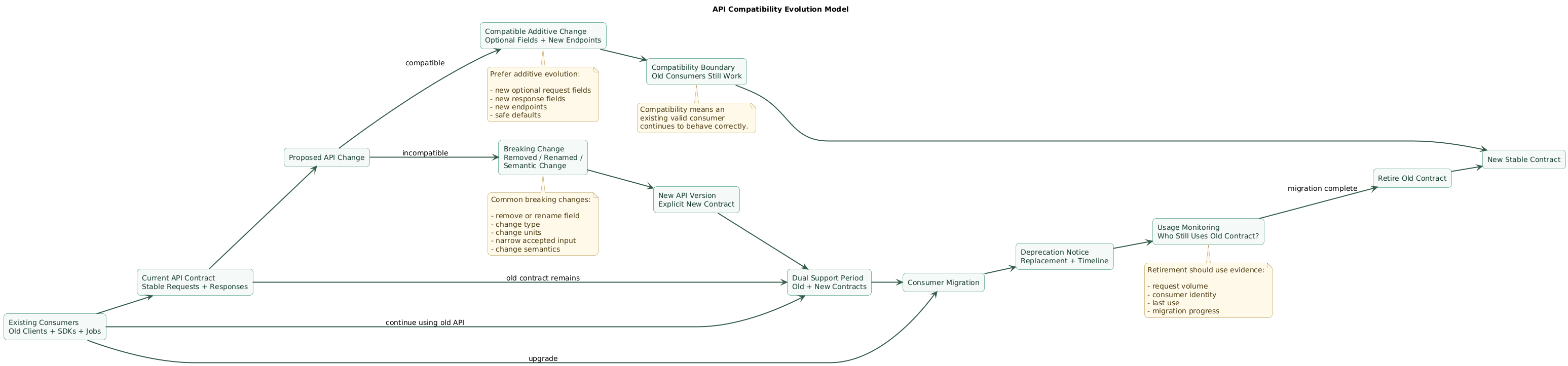
API compatibility evolution model (diagram)
A documented endpoint may expose:
URL
method
request fields
response fields
but consumers often depend on much more.
Compatibility surfaces include
field names

field types

required fields

nullability

enum values

default behavior

status codes

error codes

sorting

pagination

units

authentication

rate limits
Behavior is part of the contract
Suppose:
GET /orderscurrently returns orders:
newest firstand consumers quietly depend on that ordering.
Changing to:
oldest firstcan be breaking even if the JSON schema is unchanged.
Define compatibility rules explicitly
For example:
Consumers must ignore
unknown response fields.

New response fields
may appear at any time.

Existing enum fields may gain
documented future values.

Existing required request fields
will not be removed within a version.
Clear rules make safe evolution easier for both sides.
2. Know what actually counts as a breaking change
Removing a field
Before:

{
  "id": "123",
  "name": "Example"
}

After:

{
  "id": "123"
}
Consumers reading:
namebreak.
Renaming a field
userName

to

username
is also a removal plus an addition from the consumer's perspective.
Changing a type
"count": 12to:
"count": "12"can break generated clients and validation.
Changing units
timeout:
milliseconds
to:
timeout:
seconds
is breaking even if the type remains an integer.
Narrowing accepted input
Before:
quantity >= 0after:
quantity >= 1makes previously valid requests invalid.
Changing required authentication
Adding a new mandatory scope:
orders.readmay be a breaking contract change for existing integrations.
Changing error behavior
404 not_foundbecoming:
200
{"result": null}
changes program behavior even though the success path still works.
3. Prefer additive evolution where possible
Instead of renaming:
fullNamedirectly to:
displayNameadd the new field first.
{
  "fullName": "Ada Lovelace",
  "displayName": "Ada Lovelace"
}
Migration sequence
add new field
     ↓
support both
     ↓
migrate consumers
     ↓
deprecate old field
     ↓
remove only in incompatible version
Add optional request capabilities
Existing:
POST /search

{
  "query": "example"
}
evolved:
{
  "query": "example",
  "includeArchived": true
}
can remain compatible if:
includeArchivedis optional and has a safe default.
Additive does not automatically mean safe
A strict consumer might deserialize only:
known fieldsand reject:
unknown fieldseven though the provider only added data.
Design consumers to tolerate response growth
When possible:
ignore fields you do not understandunless rejecting unknown data is a deliberate security or protocol requirement.
4. Evolve request contracts carefully
Providers control responses.
Consumers control requests.
This makes new required request fields particularly dangerous.
Breaking request evolution
Before:
{
  "amount": 100
}
after:
{
  "amount": 100,
  "currency": "EUR"
}
with:
currency requiredbreaks all old consumers.
Compatible introduction
currency optional

default:
existing historical currency
can provide a migration window when a safe default exists.
Do not invent unsafe defaults
If:
currencycannot be inferred safely, silently selecting:
USDmerely to avoid a version change may create worse failures.
Narrowing validation is a compatibility change
Consumers may already send:
long strings
zero values
legacy enum values
empty collections
that the server historically accepted.
Measure before tightening
Where possible:
log deprecated input
     ↓
measure consumer usage
     ↓
notify consumers
     ↓
reject later
5. Make response consumers tolerant of growth
Imagine:
{
  "id": "ord_123",
  "status": "pending"
}
later becoming:
{
  "id": "ord_123",
  "status": "pending",
  "createdAt": "2026-08-30T12:00:00Z"
}
A tolerant consumer should generally continue working.
Avoid exhaustive object assumptions
Fragile:
response must contain
exactly two properties
unless exact shape is intentionally required.
Do not change existing meaning silently
Adding:
createdAtis different from changing:
status = "pending"to mean something new.
Ordering needs explicit guarantees
If clients may rely on order, document:
sort field

ascending / descending

tie-breaking behavior
Pagination is a contract
Changing:
offset paginationto:
cursor paginationmay require a migration path rather than a silent implementation swap.
6. Treat enums, nullability, and defaults as compatibility surfaces
Enum evolution
Initial values:
pending
completed
failed
later:
pending
processing
completed
failed
Exhaustive consumer code can fail
switch status:
  pending
  completed
  failed

  otherwise:
    crash
Prefer unknown-value handling
known value
     ↓
normal behavior

unknown value
     ↓
safe fallback
or
explicit unsupported state
Nullability is contractual
Changing:
name always stringto:
name may be nullcan break clients even though the field remains present.
Changing defaults can change behavior
If:
includeArchivedchanges default from:
falseto:
trueevery consumer that omitted the field receives different results.
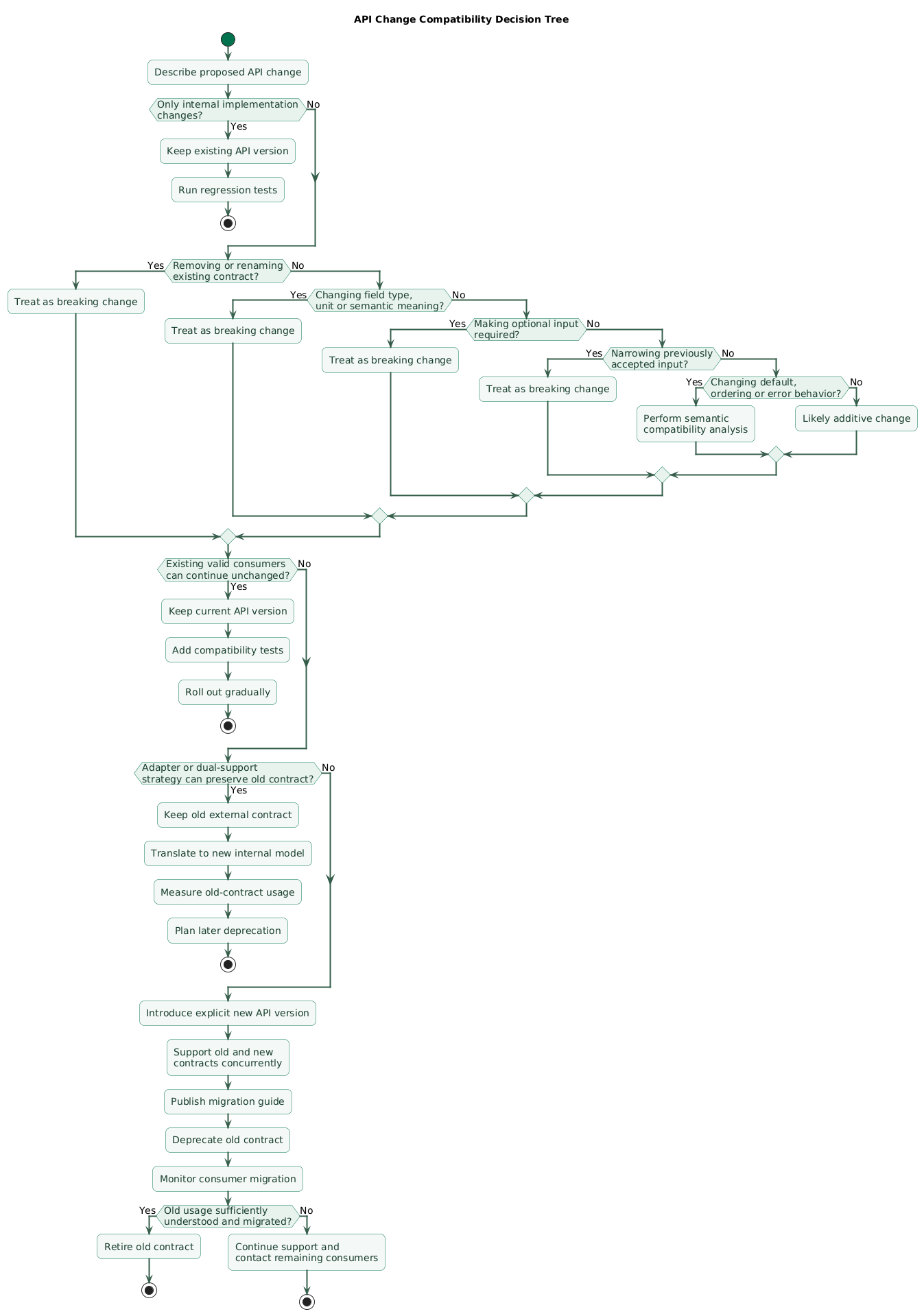
7. Version only when compatibility cannot be preserved
API change compatibility decision tree (diagram)
Do not create:
v2simply because:
the implementation changedInternal changes need no API version
database optimization

refactoring

caching

new internal service
should remain invisible if the public contract stays compatible.
Additive changes often fit the current version
new optional request field

new response field

new endpoint
may not require a new major API version.
Version when the contract must become incompatible
Examples:
replace request model

change meaning of fields

change authentication model

remove major legacy behavior

redesign error semantics
Try adapters first where reasonable
old contract
     ↓
adapter
     ↓
new internal model
can postpone forced consumer migration without duplicating the whole service.
8. Choose a versioning strategy deliberately
URL versioning
/v1/orders

/v2/orders
Advantages:
visible
simple to route
easy to test manually
Tradeoff:
version becomes part
of resource URL
Header versioning
API-Version: 2keeps resource URLs stable but makes the selected contract less visible in ordinary links and browser inspection.
Media-type versioning
Accept:
application/vnd.example.v2+json
can model representation versions explicitly but adds complexity for many ordinary APIs.
Version by date or release identifier
Some APIs expose a selected contract revision using:
date
revision
compatibility level
rather than:
v1
v2
v3
Consistency matters more than novelty
Consumers should be able to answer:
Which contract am I using?

How do I request another one?

How long will this one be supported?
Avoid per-endpoint chaos
/v2/orders

/users?version=3

header version for payments
creates unnecessary cognitive and operational complexity.
9. Treat deprecation as a managed migration
Deprecation is not:
mark old
wait
delete
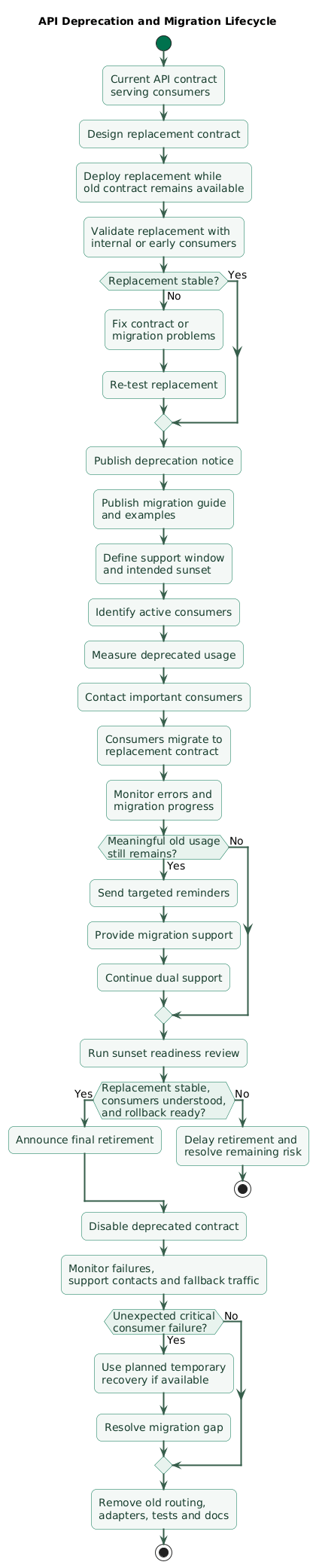
A useful deprecation process
identify old contract
     ↓
publish replacement
     ↓
write migration guide
     ↓
announce deprecation
     ↓
measure remaining usage
     ↓
contact consumers
     ↓
support migration
     ↓
retire after risk review
Explain exactly what is deprecated
Weak:
v1 is deprecated.Better:
POST /v1/payments is deprecated.

Use:
POST /v2/payment-intents

Main differences:
- idempotency key required
- amount uses minor units
- response is asynchronous
Provide a migration mapping
v1 field:
total

v2 field:
amountMinor

migration:
convert currency amount
to minor units
Document behavioral differences
Schema changes are only part of the migration.
Also explain:
new retries

new errors

new defaults

new consistency model

new authentication requirements
10. Discover and measure real consumers
Before retiring an endpoint, answer:
Who still uses it?Useful identifiers may include
API key

OAuth client

tenant

SDK version

user agent

application ID
Usage telemetry
Measure:
requests per consumer

last use

deprecated fields used

legacy version usage

error rate
Do not rely only on request volume
A consumer making:
one request per monthmay still run an important:
billing
audit
compliance
settlement
workflow.
Identify ownership
Internal APIs should ideally map consumers to:
team
repository
service
owner
Contact consumers directly
High-impact migration should not depend only on:
release note nobody reads11. Evolve schemas and events for mixed versions
Event-driven systems have a special compatibility challenge:
messages can outlive
the producer version
Old events may be replayed
A consumer deployed today may receive:
event produced months agoPrefer additive event evolution
Existing:
{
  "orderId": "123",
  "status": "paid"
}
evolved:
{
  "orderId": "123",
  "status": "paid",
  "paymentMethod": "card"
}
Avoid reusing a field with different meaning
Do not change:
amountfrom:
major currency unitsto:
minor currency unitswithout an explicit version or new field.
Schema registries can enforce compatibility rules
Where available, automated checks can reject:
field deletion

incompatible type change

required-field introduction
before an incompatible event schema reaches production.
Consumers should tolerate future data where appropriate
unknown optional field
     ↓
ignore

unknown critical version
     ↓
reject safely
12. Test compatibility explicitly
Provider compatibility tests
Verify that:
old request still works

old response field still exists

old status-code behavior remains

old authentication path remains supported
Consumer contract tests
Consumers can capture assumptions such as:
field exists

type is string

404 returned for missing resource
and providers can validate those assumptions before release.
Test old client against new server
Client v1
   ↓
Server current
Test new client against old server when relevant
Client current
   ↓
Server previous
especially when:
mobile applications

desktop software

edge installations

rolling deployments
can create mixed versions.
Use recorded fixtures carefully
Historical payloads help test:
old enum values

missing newer fields

legacy errors

old event versions
Test semantic compatibility
Schema compatibility alone will not catch:
changed ordering

changed rounding

changed default

changed authorization scope
13. Roll out incompatible migrations in stages
API deprecation and migration lifecycle (diagram)
Phase 1: introduce replacement
old API supported

new API supported
Phase 2: migrate internal consumers
Internal users provide:
early feedback

migration examples

real compatibility evidence
Phase 3: announce external deprecation
Provide:
replacement

migration guide

timeline

support channel
Phase 4: monitor migration
legacy usage:
38%
     ↓
17%
     ↓
4%
     ↓
0.2%
Phase 5: contact remaining consumers
Do not assume:
small traffic
=
unimportant consumer
Phase 6: sunset readiness review
Confirm:
remaining consumers identified

migration support available

rollback understood

support team prepared

monitoring ready
Phase 7: retire and monitor
After retirement:
watch errors

watch support contacts

watch fallback traffic
14. Retire old versions only with evidence
A calendar date is useful, but it is not enough.
Before retirement verify
active usage is understood

major consumers migrated

replacement is stable

documentation is current

support path exists

rollback or temporary restore
is understood
Do not preserve versions forever
Permanent support creates:
duplicated logic

security burden

testing cost

operational complexity

documentation debt
But do not retire blindly either
An API with:
low trafficcan still support a critical monthly process.
Define a sunset policy before you need one
A useful policy can state:
minimum notice period

communication channels

supported versions

migration support

retirement criteria
Remove compatibility code after retirement
Once the old contract is genuinely gone:
remove adapters

remove old tests

remove legacy metrics

remove deprecated docs

remove routing rules
so compatibility scaffolding does not become permanent architecture.
15. Copy/paste API evolution checklist
API design for change checklist

Contract
- What exactly is public?
- Which fields are guaranteed?
- Which behaviors are guaranteed?
- Is ordering guaranteed?
- Are defaults documented?
- Is nullability documented?
- Are error semantics documented?
- Are authentication requirements documented?
- Are rate limits documented?
- Are pagination semantics documented?

Consumer assumptions
- Can consumers ignore unknown response fields?
- Can new enum values appear?
- Can optional fields appear later?
- Can fields become populated when previously absent?
- Can order change?
- Can new error codes appear?
- Are consumers expected to preserve unknown data?

Breaking changes
- Removing field is breaking.
- Renaming field is breaking.
- Changing field type is breaking.
- Narrowing accepted input may be breaking.
- Making optional input required is breaking.
- Making non-null output nullable may be breaking.
- Changing units is breaking.
- Changing field meaning is breaking.
- Changing default behavior may be breaking.
- Changing authentication may be breaking.
- Changing authorization scope may be breaking.
- Changing status codes may be breaking.
- Changing error semantics may be breaking.
- Changing ordering may be breaking.
- Changing pagination model may be breaking.

Additive evolution
- Prefer new optional request fields.
- Prefer new response fields.
- Prefer new endpoints.
- Prefer new explicit fields over changing old meaning.
- Keep safe defaults.
- Support old and new fields during migration.
- Measure legacy-field usage.
- Remove only after migration or new version.

Request evolution
- Avoid new required fields.
- Avoid narrowing accepted values unexpectedly.
- Avoid rejecting previously accepted optional fields without migration.
- Avoid silent semantic changes.
- Add validation warnings before enforcement where useful.
- Measure deprecated input patterns.
- Document new constraints.
- Provide migration examples.

Response evolution
- Consumers should ignore unknown fields where appropriate.
- Do not remove fields silently.
- Do not change types silently.
- Do not change units silently.
- Do not reuse fields with new meaning.
- Keep stable error envelopes where promised.
- Document ordering guarantees.
- Document pagination behavior.

Enums
- Assume new values may be needed.
- Consumers should have unknown-value handling.
- Avoid exhaustive failure where future values are expected.
- Do not reuse old enum value for new meaning.
- Deprecate values before removal.
- Test clients with unknown values.

Nullability
- Document nullable fields.
- Do not introduce null where consumers expect a value without compatibility analysis.
- Prefer optional new field over changing old field semantics.
- Test missing and null separately when protocol distinguishes them.

Defaults
- Defaults are behavior.
- Changing default can be breaking.
- Document omitted-field behavior.
- Keep historical default during compatibility migration where safe.
- Avoid unsafe defaults merely to avoid versioning.

Versioning
- Do not version internal refactors.
- Do not version every release.
- Prefer compatible evolution first.
- Version when incompatible contract is necessary.
- Keep version selection explicit.
- Keep versioning strategy consistent.
- Document supported versions.
- Define retirement policy.

URL versioning
- Use consistent path structure.
- Keep routing predictable.
- Document base URL.
- Avoid unrelated per-endpoint version styles.
- Plan how old routes retire.

Header versioning
- Document exact header.
- Define default version behavior.
- Avoid ambiguous missing-header behavior.
- Ensure logs capture selected version.
- Ensure gateway forwards version correctly.

Media types
- Document exact values.
- Keep negotiation rules simple.
- Test unsupported versions.
- Avoid complexity without a real need.

Date / revision versions
- Define what date means.
- Explain compatibility guarantees.
- Define default revision.
- Preserve reproducibility.
- Document retirement rules.

Deprecation
- State what is deprecated.
- State replacement.
- State migration differences.
- Publish migration guide.
- State support window.
- Provide examples.
- Provide support channel.
- Monitor usage.
- Contact important consumers.
- Send reminders.
- Define sunset criteria.

Migration guides
- Show old request.
- Show new request.
- Show old response.
- Show new response.
- Map renamed fields.
- Explain unit changes.
- Explain semantic changes.
- Explain authentication changes.
- Explain error changes.
- Explain retry changes.
- Explain consistency changes.
- Include SDK changes where relevant.

Consumer discovery
- Identify API key.
- Identify OAuth client.
- Identify tenant.
- Identify application ID.
- Identify SDK version.
- Identify user agent.
- Map internal consumers to owners.
- Track last use.
- Track request volume.
- Track deprecated feature usage.

Telemetry
- Count requests by version.
- Count deprecated endpoint usage.
- Count deprecated field usage.
- Count migration errors.
- Track consumer identity where appropriate.
- Track unknown-client traffic.
- Keep metric cardinality controlled.
- Preserve privacy requirements.

Low-volume consumers
- Do not assume low traffic means low importance.
- Check scheduled jobs.
- Check monthly workflows.
- Check audit jobs.
- Check financial reconciliation.
- Check partner integrations.
- Contact known owners.

Compatibility testing
- Test old client with new server.
- Test new client with old server where relevant.
- Test mixed-version deployment.
- Test historical payloads.
- Test missing fields.
- Test unknown fields.
- Test unknown enum values.
- Test old errors.
- Test new optional fields.
- Test default behavior.

Contract testing
- Capture consumer assumptions.
- Validate provider before release.
- Keep contracts meaningful.
- Avoid overfitting implementation details.
- Version contract fixtures.
- Remove contracts for retired consumers.

Schema checks
- Automate incompatible field deletion checks.
- Automate type compatibility checks.
- Automate required-field checks.
- Validate event schemas.
- Validate API specifications.
- Review semantic changes manually.

Events
- Historical events may be replayed.
- Prefer additive schema evolution.
- Keep old events readable.
- Do not reuse fields with changed meaning.
- Include event version if needed.
- Handle unknown fields.
- Handle unknown enum values.
- Test replay.
- Define retention and compatibility horizon.

SDKs
- Generate SDKs consistently where useful.
- Test new server with old SDK.
- Publish migration instructions.
- Avoid forcing SDK update for every additive API change.
- Preserve deprecated methods temporarily.
- Mark deprecations in SDK documentation.
- Track SDK version usage where practical.

Adapters
- Translate old contract to new internal model.
- Keep adapter logic isolated.
- Add tests.
- Measure usage.
- Give adapter an explicit removal condition.
- Do not let temporary compatibility become permanent.

Dual support
- Support old and new contracts during migration.
- Keep behavior equivalent where promised.
- Test both paths.
- Monitor both paths.
- Avoid divergent business logic.
- Centralize shared behavior.

Dual reads
- Useful during storage migrations.
- Define source of truth.
- Compare results.
- Measure mismatch.
- Avoid indefinite dual-read complexity.
- Remove when migration proves stable.

Dual writes
- Use carefully.
- Define failure semantics.
- Avoid partial divergence.
- Monitor mismatches.
- Consider idempotency.
- Remove after migration.

Feature flags
- Gate new behavior.
- Roll out gradually.
- Keep old behavior available temporarily.
- Test both states.
- Monitor adoption.
- Define flag removal date or condition.

Staged rollout
- Internal consumers first where useful.
- Small external cohort.
- Monitor errors.
- Expand gradually.
- Pause on regressions.
- Preserve rollback.
- Separate deployment from activation.

Authentication migrations
- Support old and new credential methods temporarily where safe.
- Define scope differences.
- Provide token migration guide.
- Monitor legacy authentication usage.
- Do not silently weaken security for compatibility.
- Version when security model requires incompatible change.

Error contracts
- Stable machine-readable error code.
- Human message may evolve.
- Keep documented status codes stable where possible.
- Add new error codes carefully.
- Avoid changing failure to success response silently.
- Document retryable errors.
- Document validation details.

Pagination
- Define stable ordering.
- Define cursor semantics.
- Define page-size limits.
- Avoid changing offset to cursor silently.
- Avoid cursor format assumptions by consumers.
- Treat cursors as opaque.
- Version major pagination redesigns if necessary.

Sorting
- Document default sort.
- Document supported sort fields.
- Keep tie-breaking stable where important.
- Avoid relying on database incidental ordering.
- Test pagination with stable order.

Filtering
- Adding filter is usually additive.
- Narrowing existing filter semantics can break consumers.
- Keep unknown-filter behavior explicit.
- Document case sensitivity.
- Document timezone behavior.
- Document matching semantics.

Units
- Put unit in field name where practical.
- Document unit explicitly.
- Never change unit silently.
- Prefer new field for new unit.
- Deprecate old unit field gradually.

Dates and time
- Document timezone.
- Prefer unambiguous formats.
- Document precision.
- Do not change timezone semantics silently.
- Test old and new clients around precision changes.
- Treat date-only and timestamp values distinctly.

Money
- Document currency.
- Document major versus minor units.
- Avoid floating-point ambiguity.
- Do not change amount semantics silently.
- Treat rounding changes as behavioral compatibility changes.

Security
- Compatibility does not justify insecure legacy behavior forever.
- Define security-driven retirement exceptions.
- Communicate urgent security migrations clearly.
- Track legacy authentication.
- Remove vulnerable protocols.
- Preserve audit trail.

Gateways
- Route versions explicitly.
- Log selected version.
- Preserve headers.
- Test cache keys by version.
- Avoid serving wrong representation from shared cache.
- Keep rate-limit policy clear.

Caching
- Include contract version in cache identity where necessary.
- Invalidate safely.
- Avoid mixing representations.
- Test old and new versions behind CDN.
- Document cache behavior where consumers rely on it.

Documentation
- Document compatibility policy.
- Document supported versions.
- Document deprecated versions.
- Publish migration guides.
- Keep examples version-specific.
- Remove retired docs or clearly archive them.
- Link replacement from deprecated pages.

Release notes
- Highlight breaking changes.
- Highlight new optional capabilities.
- Highlight deprecations.
- Include migration links.
- Include effective date.
- Avoid hiding API changes in generic release notes.

Sunset policy
- Define notice period.
- Define supported versions.
- Define communication channels.
- Define migration support.
- Define retirement criteria.
- Define security exceptions.
- Define restoration / rollback policy where appropriate.

Before sunset
- Active consumers identified.
- High-impact consumers contacted.
- Migration guide available.
- Replacement proven stable.
- Usage near acceptable threshold.
- Support ready.
- Monitoring ready.
- Rollback understood.
- Documentation updated.

At sunset
- Disable old contract deliberately.
- Monitor failures.
- Monitor support traffic.
- Monitor fallback behavior.
- Preserve temporary recovery option if planned.
- Communicate completion.

After sunset
- Remove old routing.
- Remove adapters.
- Remove legacy tests.
- Remove old metrics.
- Remove deprecated SDK methods when appropriate.
- Archive or remove docs.
- Remove feature flags.
- Simplify business logic.

Internal APIs
- Track service owners.
- Track repositories.
- Test rolling deployments.
- Preserve mixed-version compatibility.
- Avoid assuming synchronized deploys.
- Use automated contract tests.
- Make ownership discoverable.

External APIs
- Assume slower consumer migration.
- Publish longer support windows where appropriate.
- Provide stable documentation.
- Provide migration support.
- Avoid requiring coordinated release.
- Measure anonymous or unknown usage where possible.

Mobile clients
- Assume old versions remain active.
- Maintain server compatibility longer.
- Test old app versions.
- Avoid mandatory new request fields without version strategy.
- Use capability detection where useful.

Final review
- Is the proposed change additive?
- Can an old valid request still succeed?
- Can an old consumer parse the new response?
- Are new enum values safe?
- Has nullability changed?
- Has default behavior changed?
- Has ordering changed?
- Has authentication changed?
- Has error behavior changed?
- Has pagination changed?
- Has semantic meaning changed?
- Is a new version actually necessary?
- Is the version selection explicit?
- Is the old version still supported during migration?
- Is the replacement documented?
- Is a migration guide available?
- Can active consumers be identified?
- Is usage measured?
- Are compatibility tests automated?
- Are mixed-version scenarios tested?
- Is staged rollout possible?
- Is rollback understood?
- Are sunset criteria based on evidence?
- Will temporary compatibility code be removed after migration?
16. FAQ
What is a breaking API change?
A breaking change makes a previously valid consumer fail or behave differently. Removing or renaming fields, changing types or units, narrowing accepted input, changing authentication, or altering established semantics can all be breaking.
Should every API change create a new version?
No. Compatible additions and internal implementation changes usually do not require a new version. Versioning is most useful when the required public contract cannot evolve safely while preserving existing consumers.
Is adding a response field always backward compatible?
Not necessarily. Well-designed tolerant consumers usually ignore unknown fields, but strict deserializers or schema validators may reject them. Compatibility depends on the contract and consumer behavior, not only on whether a change looks additive.
Which API versioning strategy is best?
There is no universal choice. URL, header, media-type, date, and revision strategies can all work. Choose one that is explicit, consistent, observable, testable, and understandable to consumers.
How long should an API deprecation period last?
The appropriate period depends on consumer type, migration complexity, contractual commitments, security concerns, and release cadence. Define a policy, but also measure actual usage and understand remaining consumers before retirement.
How do you test API compatibility?
Test old clients or fixtures against the new provider, use contract and schema checks, exercise unknown fields and enum values, verify error behavior, and test mixed-version deployments wherever provider and consumer releases can overlap.
When can an old API version be removed?
Remove it when the replacement is stable, important consumers have migrated, remaining usage is understood, support and monitoring are ready, and the team has reviewed the operational consequences of retirement.
Key terms (quick glossary)
- Backward compatibility
- The ability of a newer provider or contract to continue supporting existing consumers that use the previous valid behavior.
- Breaking change
- A change that can cause an existing valid consumer to fail or behave incorrectly.
- Additive change
- A change that extends a contract, such as introducing a new optional field or endpoint, without intentionally removing existing behavior.
- API version
- An explicitly selectable representation of an API contract used when incompatible behaviors must coexist.
- Deprecation
- A lifecycle state indicating that a contract is still available but should no longer be used for new integrations and is planned for retirement.
- Sunset
- The planned retirement of an API version, endpoint, field, or other contract after a migration period.
- Compatibility window
- A period during which old and new consumers or providers can coexist safely.
- Tolerant reader
- A consumer designed to read the data it needs without unnecessarily rejecting compatible additional information.
- Schema evolution
- The controlled modification of structured data contracts over time while considering compatibility with existing producers and consumers.
- Consumer contract
- A formal or tested representation of assumptions a consumer makes about a provider's API behavior.
- Adapter
- Compatibility code that translates one external contract or model into another representation.
- Dual support
- A migration period during which both the old and replacement contracts remain available.
- Mixed-version deployment
- A state where different versions of clients, servers, or services operate simultaneously.
- Migration guide
- Documentation explaining how consumers move from a deprecated contract to its replacement.
- Semantic compatibility
- Compatibility of meaning and behavior rather than only compatibility of syntax or schema.
- Contract test
- An automated test that verifies assumptions between a service provider and one or more consumers.
Worth reading
Recommended guides from the category.