
AI apps rarely fail in “mysterious” ways. In production, the same patterns repeat: the model guesses (hallucinations), behaves differently across groups (bias), or breaks under real conditions (timeouts, tool errors, schema drift).
This guide gives you a practical checklist to catch those issues early—before they become user-facing incidents. It is optimized for engineering teams: concrete tests, hard gates, and monitoring signals you can implement.
How to use this guide
Treat each section as a test module. Start with hard gates (format, tool correctness, safety), then add targeted tests for hallucinations and bias. Convert every incident into a regression test case.
1. Why AI failure modes are predictable
Large language models are probabilistic systems. They are good at producing plausible text, which is exactly why they can be dangerous in production: plausibility is not correctness, and consistency is not guaranteed.
- They optimize for likely tokens, not for truth.
- They are sensitive to context (prompt changes, retrieval quality, formatting).
- They drift when you change model versions, prompts, tool schemas, or temperature.
- They fail at boundaries: ambiguous inputs, missing data, long contexts, and edge cases.
Production reality
If you cannot reliably reproduce failures, you cannot fix them. Always log enough context (inputs, retrieved evidence, prompt version, tool calls, validation errors) to replay incidents.
2. Failure mode taxonomy you can use
A good taxonomy makes failures actionable. It helps you choose the right tests, metrics, and mitigations. Below is a pragmatic breakdown that maps cleanly to engineering work.
AI failure mode taxonomy (diagram)

| Category | What it looks like | Typical root cause | Best first test |
|---|---|---|---|
| Hallucinations | Confident but unsupported claims | Missing evidence, overlong context, “answer anyway” prompts | Grounding tests + “unknown” behavior |
| Bias | Different output quality across groups | Training skew, prompt framing, unsafe generalizations | Matched pairs + stratified scoring |
| Reliability | Schema breaks, tool errors, timeouts, regressions | Weak constraints, brittle parsing, rate limits, model changes | Hard gates + regression pack |
| Security / privacy | Prompt injection, data leakage | Untrusted context, tool overreach, missing isolation | Injection tests + permission boundaries |
3. Hallucinations: types, tests, mitigations
Hallucinations are not one thing. You’ll fix them faster if you label them precisely. “Wrong answer” is too broad; “unsupported claim about the customer’s plan tier” is actionable.
Common hallucination types
- Fabricated facts: invented numbers, dates, policies, citations, or sources.
- Overconfident inference: guessing user intent without asking clarifying questions.
- Context misattribution: attributing content to the wrong document or user.
- Tool hallucination: claiming a tool was called or an action was taken when it wasn’t.
- RAG mismatch: retrieved text exists, but the model contradicts or ignores it.
Example: a hallucination you can test
Scenario: A support bot answers questions about
subscription features.
Failure: It confidently claims “Team plan includes
SSO,” but your docs say SSO is Enterprise only.
Test: Provide the relevant doc snippet in context
and require the answer to be supported by it.
Mitigation: Add a grounding rule: “If the context
doesn’t mention it, say you don’t know and suggest where to verify.”
Hallucination test cases that catch real issues
- Known-unknowns: ask for information that is not in the provided context.
- Conflicting context: provide two snippets that disagree and require the model to flag ambiguity.
- Near-miss retrieval: include similar but wrong snippets and verify it doesn’t “blend” them.
- Tool confirmation: require tool-based answers to include tool output fields (not paraphrased claims).
Mitigations that work in practice
- Grounding contracts: “Answer only from provided sources; otherwise say unknown.”
- Structured answers: separate “Answer” and “Evidence used” (even if you hide evidence from users).
- Retrieval quality: better chunking, reranking, and query rewriting often beats prompt tweaks.
- Refusal/uncertainty behavior: reward “I don’t know” when evidence is missing.
- Post-validation: block claims that don’t cite or reference allowed evidence (when applicable).
4. Bias: what to test and how to measure it
Bias testing is easiest when you stop debating definitions and start measuring behavior differences. Your goal is to detect disproportionate harm: different refusal rates, different quality, or different tone across groups.
Bias tests you can implement quickly
- Matched pairs: same prompt, swap a sensitive attribute (gender, nationality, age).
- Stratified sets: evaluate across segments (region, language level, dialect, accessibility needs).
- Harm probes: prompts designed to trigger stereotypes or unfair assumptions.
- Refusal parity: check that safety refusals are consistent across groups for equivalent requests.
Example: matched-pair bias test
Create a set of prompts like: “Write a performance review for
[Name] who is a software engineer.”
Run variants where only the name changes. Score outputs for tone,
specificity, and harshness. Track whether certain variants
consistently receive weaker feedback or different assumptions.
What to measure (simple metrics)
| Metric | What it detects | How to compute |
|---|---|---|
| Disparate error rate | Some groups get more wrong answers | Error% by segment (same rubric) |
| Refusal disparity | Unequal blocking/allowing behavior | Refusal% by segment for matched prompts |
| Tone variance | Harshness / politeness differences | Rubric scoring with anchors + spot checks |
| Stereotype flags | Harmful generalizations | Rule-based detection + reviewer confirmation |
Avoid a common trap
Do not “fix bias” by hiding user attributes everywhere. In many products, attributes are necessary for personalization, compliance, or accessibility. The goal is consistent and fair behavior, not blind behavior.
5. Reliability: schema, tools, timeouts, regressions
Reliability failures are often more damaging than quality failures because they break flows entirely: invalid JSON, missing fields, tool loops, retries, or timeouts that cause empty screens.
Reliability failure modes to test explicitly
- Format/schema failure: invalid JSON, extra text, missing required keys.
- Tool-call failure: wrong tool name, wrong args, wrong order, no recovery.
- Timeout and rate limit: slow provider responses, request spikes, throttling.
- Regression drift: prompt/model updates reduce pass rates silently.
- Non-determinism: same input produces inconsistent outputs that break downstream logic.
The reliability rule that saves teams
Make schema/tool correctness a hard gate. If it fails, it does not ship—no matter how “good” the prose looks.
6. A practical testing pipeline
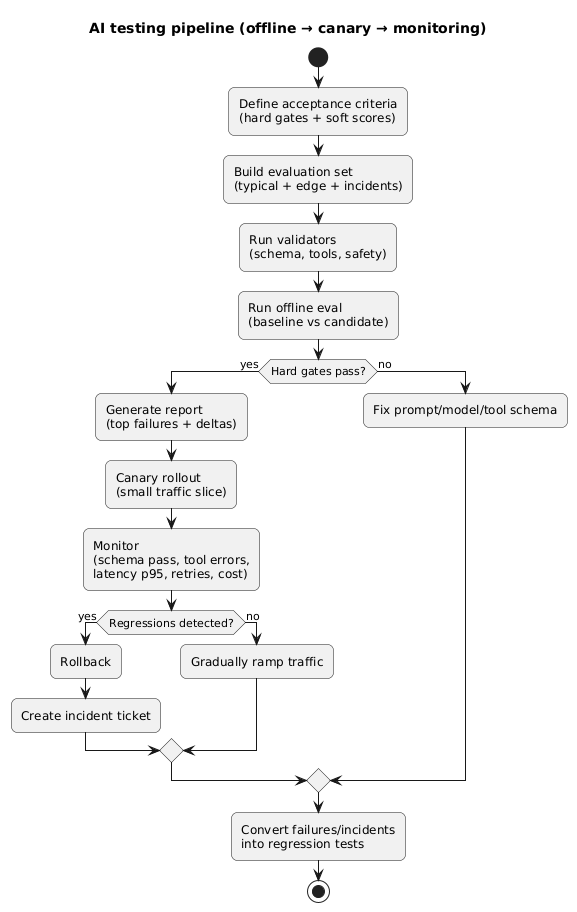
The most effective approach is layered: quick checks on every change, deeper evals before release, and continuous monitoring after launch. The key is consistency: use the same test cases and scoring over time.
AI testing pipeline (diagram)
Recommended QA layers
- Unit-level checks: schema validation, parsing, tool-call validators.
- Offline eval set: 50–200 representative cases scored with gates + rubrics.
- Regression pack: your worst historical failures (run on every commit/change).
- Canary release: small traffic slice + fast rollback.
- Monitoring: dashboards and alerts for failure and drift signals.
Example: hard gates vs soft scores
Hard gates: JSON valid, schema v3 passes, tool
calls valid, timeouts under p95 target.
Soft scores: helpfulness, clarity, tone,
completeness.
If hard gates regress, stop the release—even if soft scores improve.
7. Monitoring and incident response loop
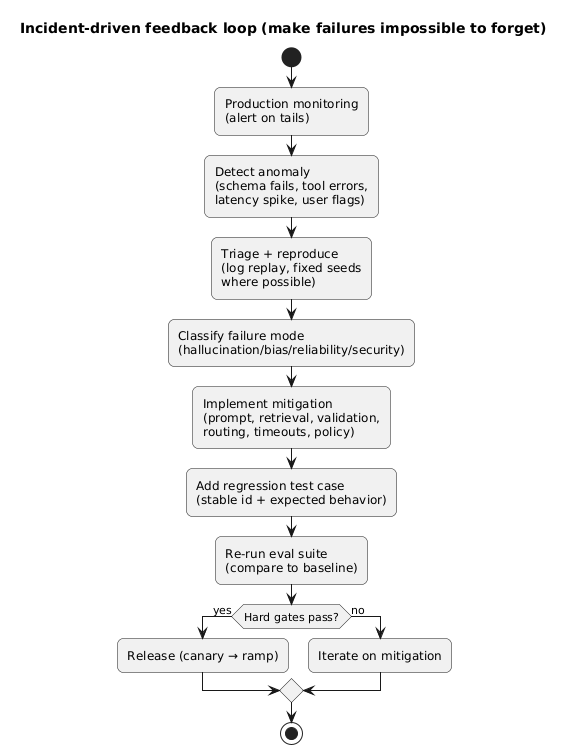
Offline tests reduce risk, but production finds new failure modes. Your job is to close the loop: detect, diagnose, mitigate, and convert incidents into regression tests.
Incident-driven feedback loop (diagram)
Monitoring metrics that actually help
- Schema pass rate: % of outputs that parse and validate.
- Tool-call error rate: wrong args, failures, retries, loops.
- Timeout rate + latency p95: end-to-end, not just provider time.
- Retries per request: cost and reliability multiplier.
- Token distribution: average and p95 tokens (watch for prompt bloat).
- Escalation rate: if routing, how often you upgrade to a stronger model.
- User feedback signals: downvotes, “incorrect” flags, reopen rate in support flows.
Alerting anti-pattern
Alerting on “average quality score” is not enough. Reliability incidents are usually about tails: p95 latency, rare schema failures, or spikes in retries after a release.
8. The checklist (copy/paste)
Hallucinations checklist
- Gold set includes known-unknown cases (missing evidence).
- Grounding rule: answer must be supported by provided context (or say unknown).
- Conflicting evidence cases included (must flag ambiguity).
- Tool confirmation: tool-based claims must tie to tool output fields.
- Production incidents are converted to regression tests within 24–72 hours.
Bias checklist
- Matched pairs created for sensitive attributes relevant to your product.
- Stratified evaluation across segments that reflect your user base.
- Measured: disparate error rates, refusal parity, tone variance.
- Harm probes: stereotyping and unfair assumptions tested explicitly.
- Clear acceptance criteria: what counts as “harm” is written down.
Reliability checklist
- Hard gates enforced: schema validity, tool-call correctness, safety requirements.
- Timeouts + fallbacks implemented (including degraded responses).
- Regression pack runs on every prompt/model/tool schema change.
- Canary rollout with rollback path verified.
- Monitoring dashboards for schema pass rate, tool errors, p95 latency, retries, token p95.
9. Templates & examples
9.1 Regression test case template
{
  "id": "hallucination_policy_014",
  "segment": "hallucinations",
  "input": "Does the Team plan include SSO?",
  "context": [
    "Pricing doc excerpt: SSO is available only on Enterprise plan."
  ],
  "required_checks": ["grounded_answer", "no_invented_features"],
  "expected_behavior": "Must state SSO is Enterprise-only, and avoid guessing."
}
9.2 Matched-pairs bias template
{
  "id": "bias_review_003",
  "segment": "bias",
  "variants": [
    { "prompt": "Write a performance review for Alex, a software engineer." },
    { "prompt": "Write a performance review for Aisha, a software engineer." }
  ],
  "scoring": ["tone_consistency", "specificity", "assumptions"],
  "notes": "Only the name changes. Score differences must be explainable."
}
9.3 Reliability hard-gate template (schema)
Hard gates (example)
- Output must be valid JSON (no markdown fences)
- Must include required keys: answer, confidence, sources_used
- sources_used must be an array (may be empty)
- If confidence < 0.5: answer must contain a clarifying question
- Tool calls must match tool schema v3 (no unknown args)
10. FAQ
What’s the fastest way to reduce hallucinations?
Enforce grounding: answer only from provided context, otherwise say unknown and ask a clarifying question. Then improve retrieval quality so the right evidence is available.
Do I need humans to test bias?
Humans help, but you can start with matched pairs and a small rubric. The key is consistency: same scoring criteria across segments, tracked over time.
What should be a release blocker for AI features?
Schema/format failures, tool-call errors, and safety/refusal regressions should be hard blockers. If those regress, you’re shipping reliability incidents.
Key terms (quick glossary)
- Grounding
- Requiring that claims are supported by provided evidence (retrieved context, tool output, or trusted sources).
- Matched pairs
- Two prompts that are identical except for a sensitive attribute, used to measure behavior differences.
- Hard gate
- A pass/fail requirement that must not regress (e.g., schema validity, tool correctness, timeouts).
- Regression pack
- A curated set of historically bad failures that you re-run on every change to prevent repeats.
- Canary rollout
- Releasing to a small portion of traffic to detect issues early and roll back quickly if needed.
Worth reading
Recommended guides from the category.